The Biggest AI Checks This Week Went to Running Models, Not Building Them
Author
Oleksandr Kotliarov
Date
July 30, 2026
Reading Time
9 min
The largest AI funding rounds in the week ending June 26 went to companies that run models, not companies that build them. Baseten raised $1.5B and Groq raised $650M — both for inference, the part of the stack that turns a trained model into a response a user actually waits on. That is the signal worth reading. When capital concentrates on serving instead of training, it is telling you which layer of the stack just became a commodity you rent rather than a system you staff.
Funding news is usually consumed as a leaderboard: who raised the most, at what valuation, who is now a unicorn. For an engineering leader that framing is close to useless. A round size tells you what investors believe about a company’s growth curve. It tells you nothing about whether your team should touch the product. The more useful sort is boring: for each company in the week’s roundup, ask whether you would ever put it in your architecture — and if so, what it replaces that you would otherwise have built. Sorted that way, the Crunchbase roundup splits cleanly into three piles: rent it now, watch it, and ignore it (but note what it signals).
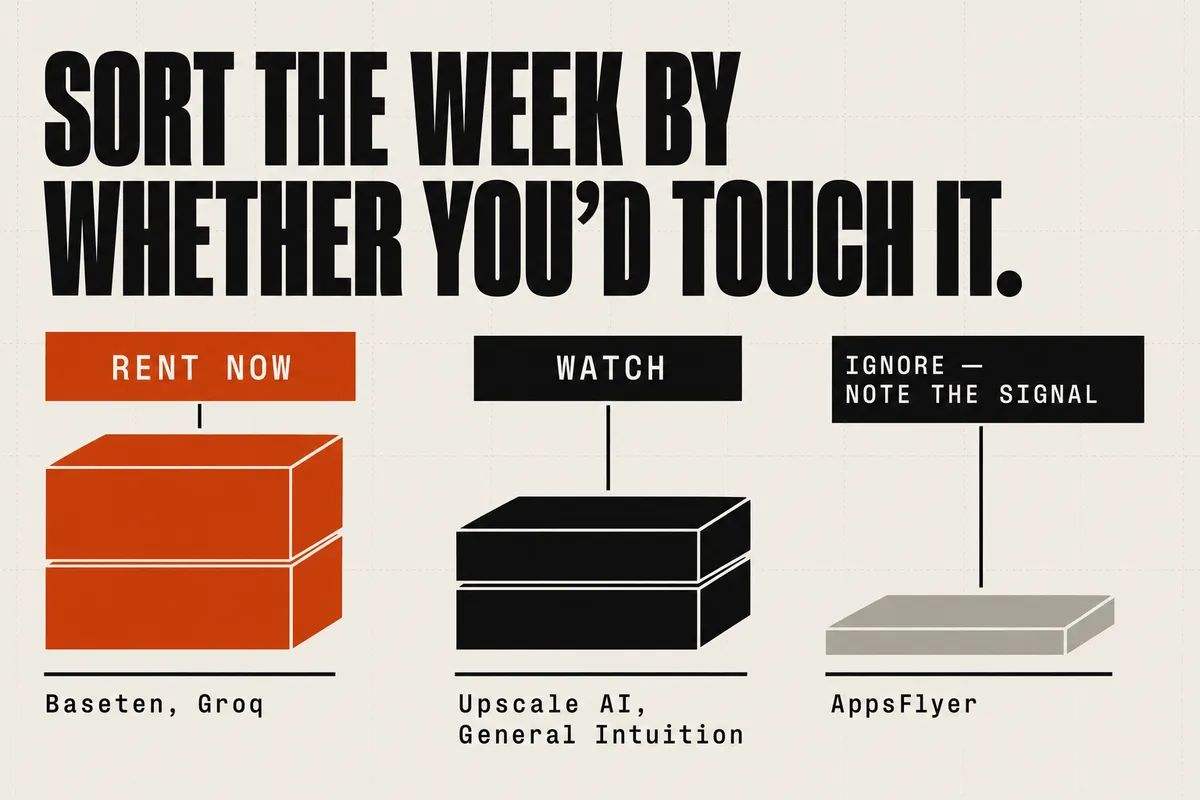
Rent it now: inference is no longer yours to build
The two biggest rounds are the two most relevant to you, which does not usually happen.
Baseten raised a $1.5B Series F at a $13B valuation. What it sells is managed inference: you hand it a model — an LLM, an embedding model, text-to-speech, image generation — and it gives you a low-latency endpoint that stays up across multiple clouds, with the runtime optimization (batching, quantization, autoscaling to zero) handled for you. Baseten says it serves on the order of a billion inference calls a day across 87 clusters on 18 clouds. Treat that as a vendor claim, not a fact you can audit. The number that matters to you is different: the count of engineer-weeks you would spend building the same thing and keeping it up.
Because that is the real problem it solves. Serving a model in production is not the same task as calling an API in a notebook. You need it fast under load, available when a region degrades, and cheap enough that unit economics survive scale. Teams routinely underestimate this and lose a quarter to GPU autoscaling, cold-start latency, and cross-region failover before shipping the feature that was supposed to take two weeks. Renting that layer is often the correct call, the same way almost nobody runs their own Postgres on bare metal anymore.
Groq is the other inference bet, and a different shape of one. Its $650M Series E funds an inference cloud built on its own chip, the LPU, designed for throughput and low latency rather than the general-purpose flexibility of a GPU. If your workload is latency-critical — a realtime voice agent, an interactive assistant, a recommendation path in the request loop — Groq’s pitch is tokens-per-second and cost-per-token that GPU inference struggles to match. The caution is coupling. A custom-silicon inference cloud is a deeper dependency than a cloud-agnostic layer like Baseten; the exit cost is higher if pricing or the roadmap moves against you. Groq’s relationship with NVIDIA has been the subject of loud reporting and murky numbers this year — enough that I would not build a specific figure into a plan. The durable point stands without it: the money is going to the companies that make inference fast and cheap, because that is where the operational pain now lives.
The take-away from this pile is not “adopt Baseten.” It is that inference has crossed the line most infrastructure eventually crosses — from something you differentiate on by building to something you differentiate on by choosing well. The competitive field is crowded (Modal, Replicate, Together, Fireworks, Lambda, and the hyperscalers’ own endpoints all sell versions of this), so the $13B headline says “best-funded,” not “winner.” Your job is a vendor evaluation, not a build.
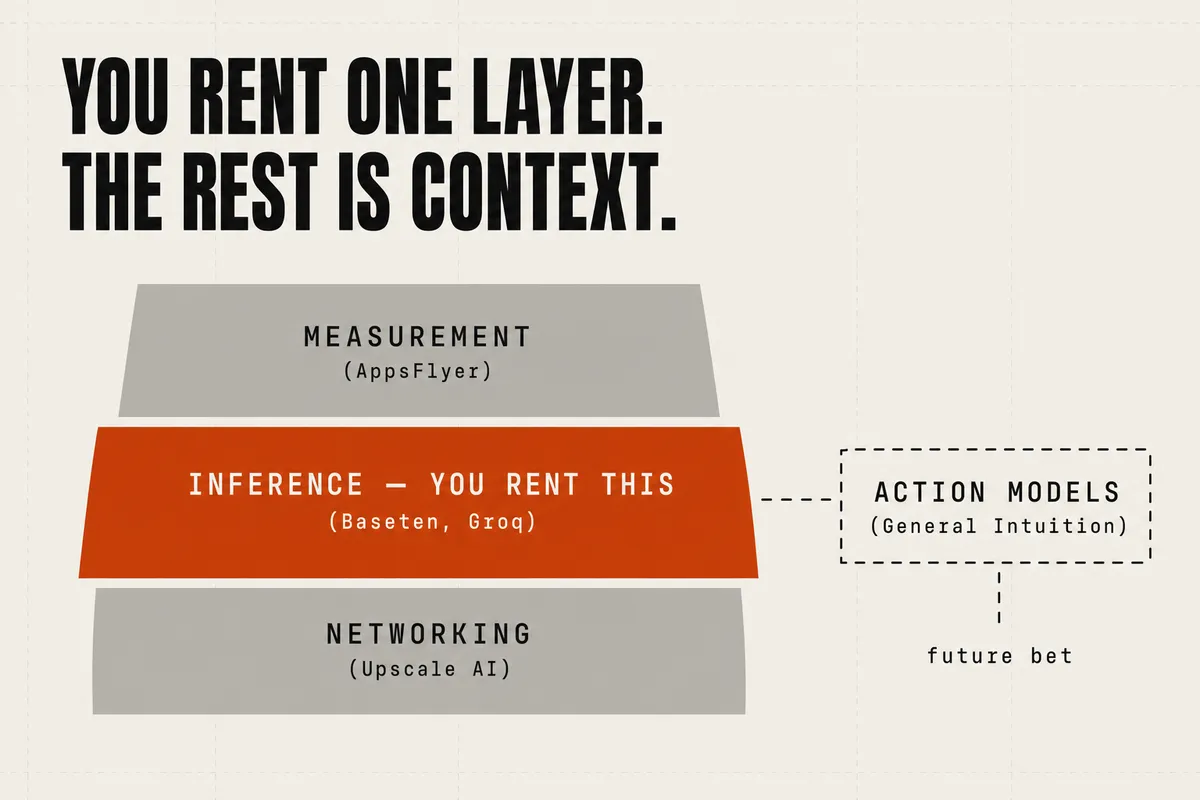
Watch it: the layer below, and the layer after
Two rounds sit in the “interesting, not yet yours” pile, one below the inference layer and one beyond it.
Upscale AI raised a $190M Series A-1 at a $2B valuation, roughly $500M total in under 18 months, to build AI-native networking — the hardware and software that link chips, memory, and storage inside a training or inference cluster. The problem is real: at scale, the bottleneck is often not the GPUs but the fabric between them, and idle accelerators waiting on data are the most expensive idle in the building. But it is a problem you only own if you run your own large clusters. If you rent inference (see the pile above), Upscale is solving something your provider worries about, not you. Worth understanding as context for why your inference bill has the shape it does. Not worth a line in your architecture. Networking has also historically commoditized, so “the Cisco of AI” framing is a thesis, not a result.
General Intuition is the one to actually keep an eye on, precisely because it is not a tool yet. It raised a $320M Series A at a $2.3B valuation to train “action models” on billions of gameplay clips — teaching systems to make decisions from human play rather than from static text. The bet is that agents which learn to act in game environments will transfer to acting in the real world. That transfer is unproven at scale, and the honest label for the raise is “a well-capitalized bet,” not “a solved problem.” But the direction it points — from stateless models that answer to systems that decide and act — is the one most likely to change what “AI feature” means in your product over the next few years. Watch it the way you watched agent frameworks two years before you shipped one. Don’t stake a roadmap on it this quarter.
Ignore it, but read the signal: the $1B that isn’t for you
AppsFlyer raised $1B at a $2.7B valuation, the biggest single check in the roundup, from strategic investors including Google, Meta, and Unity. It sells marketing attribution and measurement, now with AI-driven campaign workflows layered on. For most engineering teams this is not a tool you integrate; it is your growth team’s problem. So why note it at all? Because the biggest check went to a company whose moat is a specialized data-and-measurement layer, not a foundation model — and it drew strategic money from the platforms that could most easily build a foundation model themselves. That is a quiet argument that durable AI value is accruing in narrow, data-rich verticals, not in another general-purpose model. Useful context when you decide whether your own “AI feature” is defensible or just a wrapper.
What to do Monday morning
Stop reading funding news as a scoreboard and start reading it as a map of where the build-vs-buy line is moving. This week’s map is legible:
- Inference is a buy. If you are still hand-rolling model serving, price out a managed layer before you staff another quarter of infra work. Run the vendor eval across at least Baseten, one silicon-specialized option like Groq if you are latency-bound, and your existing cloud’s native endpoints. Decide on latency, cost-per-token at your real volume, and how expensive it is to leave.
- Cluster networking is not your problem unless you own the cluster. If you rent inference, Upscale is a line item inside someone else’s margin, not yours.
- Action models are a watch, not a dependency. Track General Intuition and its category the way you track anything that could reshape your product’s interaction model, without betting the roadmap on transfer that hasn’t been demonstrated.
- Check your own moat. If the durable money is going to specialized, data-rich layers rather than general models, ask honestly whether your AI feature is one of those — or a thin wrapper that a model provider ships as a checkbox next quarter.
The valuations will keep climbing and the headlines will keep sorting themselves by round size. Read them by relevance instead, and a week of AI funding stops being noise and becomes a fairly precise readout of which layers of your stack you should stop building.
References
WEEKLY NOTE
One note per week.
One short note from current work plus 2–3 outside links worth your time.

Oleksandr Kotliarov
Founder · Engineering Lead · Kraków, Poland
I build engineering teams that ship — from MVP to Series A delivery.