Author
Oleksandr Kotliarov
Date
July 25, 2026
Reading Time
19 min
“Which is better, a large model or a small one” is the wrong question, and it produces bad architecture. Model size is a deployment axis — a decision about where inference runs, what it costs per call, and how narrow the task is — not a single quality score you can rank two models against.
Here is the number that makes the point. A team at Predibase fine-tuned 310 small models across 10 base models and 31 tasks. On 224 of those 310 runs, the fine-tuned model beat GPT-4 outright, and across the suite the fine-tunes averaged ten points above it. The original 25-model Mistral-7B cohort cost about eight dollars each to train on a single A100. That result is only surprising if you believe a smaller model is a worse model. It isn’t a worse model. It’s a different tool, pointed at a different job.
The rest of this piece takes the reframe seriously and refuses to fence-sit. For each concrete use case — agentic sub-tasks, on-device inference, high-volume classification, RAG, open-ended reasoning, and regulated data — we pick a winner and show the number behind the pick.
One warning, because it shapes how you should read every benchmark below. We rebuilt this piece in July 2026 and re-checked each load-bearing number against its primary source. Several didn’t survive. The most-quoted fact in the small-model case — that an 8B model beat GPT-4 and Claude on the Berkeley Function Calling Leaderboard — was true in 2024 and is not true now. We keep the verdict it supported, on different evidence, and show our work. Benchmark claims here have a shelf life, and most writing about them doesn’t check the date.
The boundary sits around 10B, and it moves
Before the trade-offs, the definition, because the whole argument depends on it. Microsoft’s own Azure documentation draws the line at ten billion parameters: under 10B is a small language model, over 10B is a large one. NVIDIA’s agentic-AI paper lands in the same place and says so plainly: “we would be comfortable with considering most models below 10bn parameters in size to be SLMs.” Two vendors with different incentives converged on the same threshold, which is about as much consensus as this field offers.
The line is real but soft, and it is drifting. Microsoft’s own table classifies Phi-3-medium (14B) as “large,” which no engineer shipping against a frontier model would say with a straight face. The categories were coined when 70B to 175B was the frontier. Now that frontier models reach past a trillion parameters, the practical split has settled into three bands: sub-10B is small, 70B and up is large, and the 14B-to-40B middle gets called either depending on who is selling.
NVIDIA’s functional definition is the more useful one, and it points at deployment rather than parameter count: a small model is one that can run on a common consumer device with latency low enough to be practical. That is the definition worth carrying, because it is the one that decides architecture. In 2026 terms it means roughly 3B to 10B of active parameters — a distinction that matters more than it used to, as the on-device section will show.
Phi-4 lives in the contested middle at 14B, and it is the cleanest evidence that the band matters more than the label. On MATH it scores 80.4% against GPT-4o’s 74.6%, and on GPQA 56.1% against 50.6% — beating the very model that generated much of its training data. Call it small or call it large; what it demonstrates is that parameter count stopped being a proxy for capability on well-defined tasks some time ago.
The axes that actually differ
Five dimensions separate the classes in practice. On some the small model has closed the gap entirely. On others the gap is physics and will not move. Sorting which is which is the whole game.
Privacy is deliberately not on the list, though it heads most comparisons. It isn’t an axis where the classes differ — a self-hosted model inside a controlled VPC satisfies the same obligations at 7B or 70B. It is a constraint on location, and it only touches size in one narrow case. The regulated-data verdict handles it.
Capability: closed on narrow, open on broad
The gap is closed — fully — on structured, learnable tasks. Phi-4 beating its teacher on MATH is one data point, and the pattern holds across model families: on math competitions, code generation, and constrained extraction, a small model tuned for the task matches or beats a frontier model.
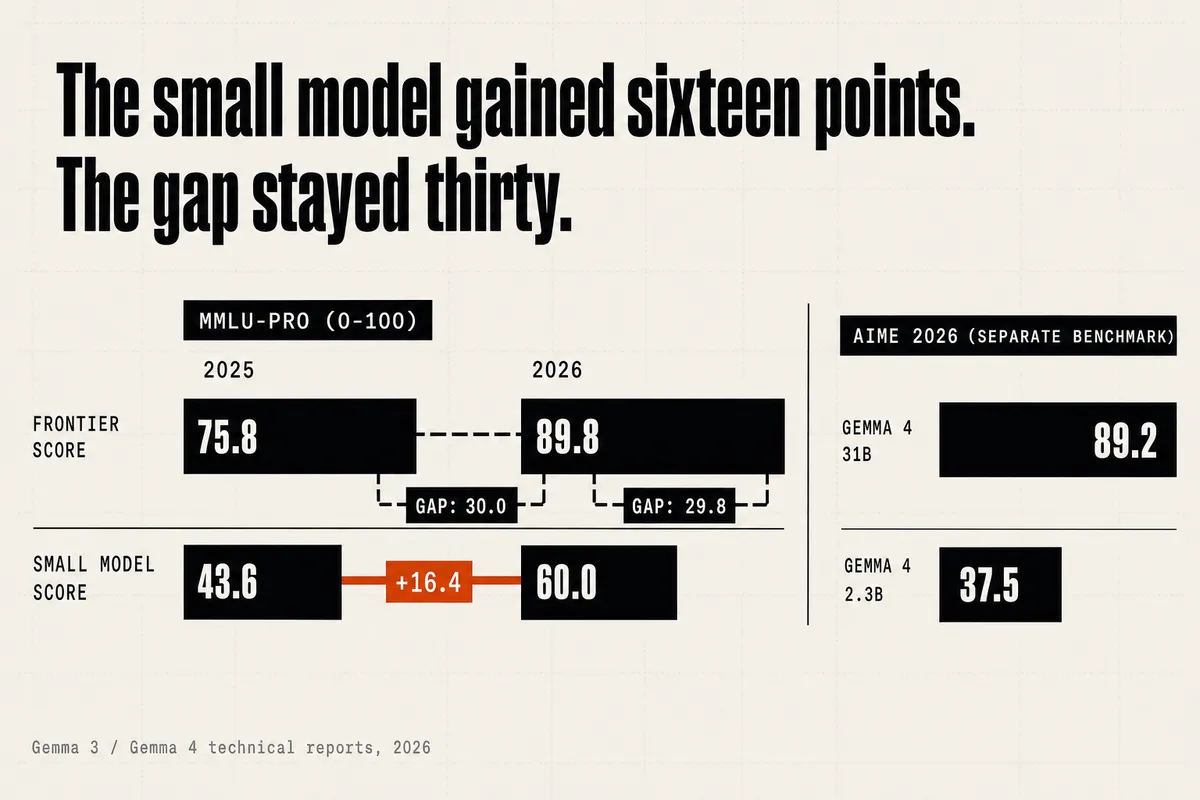
The gap is wide open on broad, unscoped knowledge, and it has stayed open through a full generation of releases. In early 2025, Gemma 3’s 4B model scored 43.6 on MMLU-Pro against Gemini 1.5 Pro’s 75.8 — a 32-point chasm on a benchmark built to probe breadth rather than a narrow skill. The obvious rejoinder is that small models have improved since. They have, substantially: Gemma 4’s smallest model reaches 60.0 with 2.3B effective parameters, a large jump in about a year.
It didn’t close the gap. Current frontier scores 89.8 on the same benchmark. The small model gained sixteen points and the frontier gained fourteen, so the distance is still roughly thirty. Both boats rose. And the sharpest version of the comparison is inside a single family, trained by one team on one recipe: on AIME 2026, Gemma 4’s 2.3B model scores 37.5 against its own 31B sibling’s 89.2. That is a 51.7-point gap that no difference in training data or lab competence explains. Broad, open-ended reasoning scales with parameter count because the knowledge it draws on is stored in the parameters. That is a memory-capacity limit, not a training deficiency you can tune away.
Cost per token: it depends who is selling it to you
NVIDIA’s central economic claim is the sturdiest cost number in the literature because it is a physics argument, not a price sheet: serving a 7B model is 10–30x cheaper — in latency, energy, and FLOPs — than serving a 70–175B model. That multiplier holds whoever is doing the serving, because it comes from the compute rather than the billing. It is a claim about self-hosted economics, and it re-verified intact.
Hosted API pricing is a different mechanism, and it does not produce one clean ratio. This is where the earlier version of this piece was lazy, so here are the current numbers from the vendors’ own pricing pages, July 2026. Anthropic charges $1/$5 per million input/output tokens for Haiku 4.5 and $5/$25 for Opus 4.8 — a flat 5x. OpenAI runs GPT-5.4-nano at $0.20/$1.25 against GPT-5.4 at $2.50/$15, roughly 12x. Google prices Gemini 2.5 Flash-Lite at $0.10/$0.40 against Gemini 3.1 Pro at $3.60–7.20/$21.60–32.40, which lands somewhere between 36x and 80x.
Five to eighty. There is no industry ratio, and anyone quoting one is quoting 2024. The spread is more useful than a single figure: the price of capability is a vendor’s pricing decision, not a property of the models. On Anthropic’s tiers a small model saves 5x, which is real but rarely worth an architecture. On Google’s it can save 80x, which is worth restructuring for. Run the arithmetic on the vendor you actually use.
Latency: real when you own the serving stack, murky when you don’t
The intuition is that a small model answers faster. On hardware you control, that is true and it is physics — on-device models hit conversational latency because there is no network round-trip, which is a category difference rather than a percentage.
At the API layer, model size gets swamped. Benchmark data on GPT-4o against GPT-4o mini disagrees with itself about which is actually faster: one run puts the mini at ~85 tokens/sec against the flagship’s ~77, another puts the flagship at ~103 against the mini’s 80–100. Time-to-first-token varies more by provider than by model — 1.53s on Azure against 2.20s hitting OpenAI directly, same model. On identical Apple silicon, two runtimes serving one model post a 2.7x throughput gap.
So the defensible claim is narrow: small models are faster when you control the serving stack. Behind a hosted, load-balanced endpoint, the provider’s infrastructure and current load move your latency more than parameter count does. Measure your own path, and note that a tokens-per-second figure in a vendor post is almost always prefill rather than sustained decode.
Deployment footprint: the gap that is physics
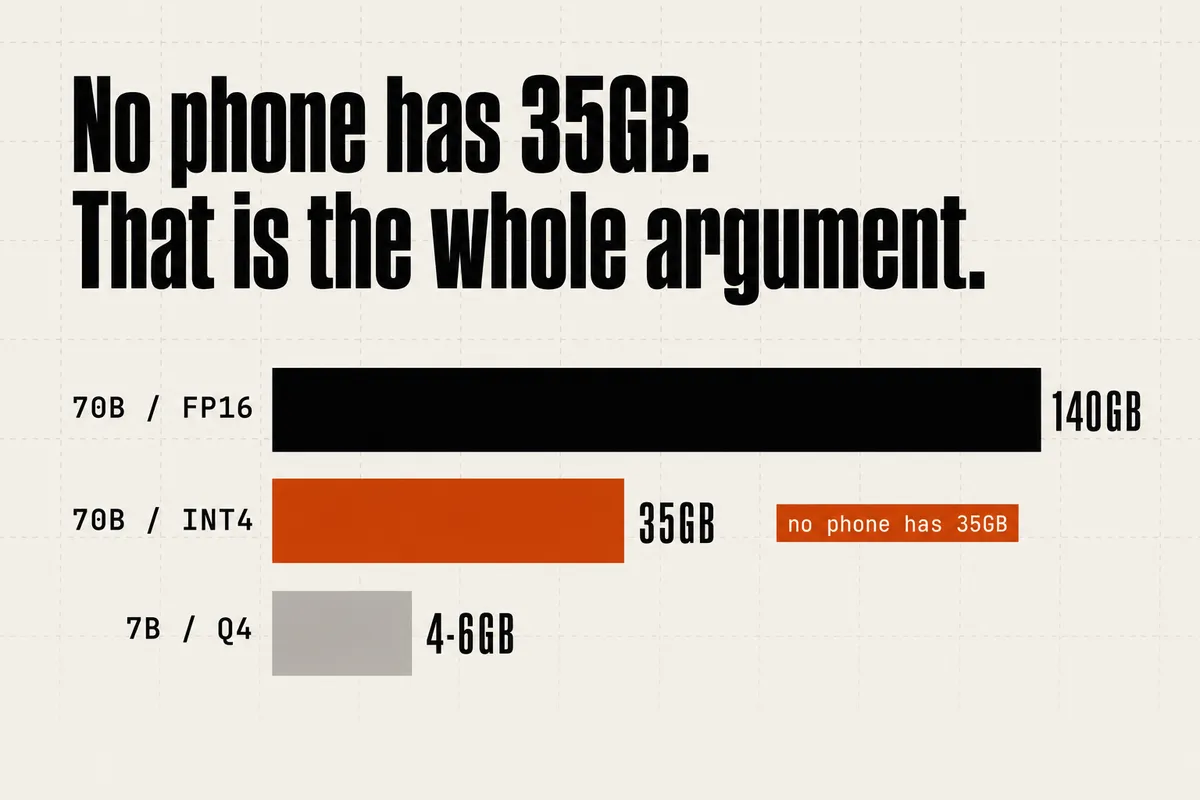
This is the one trade-off no model update will erode, because it is memory arithmetic. A 70B model needs roughly 35GB of VRAM even at aggressive INT4 quantization; unquantized in FP16 it wants ~140GB. No shipping phone has 35GB of usable memory for a single model, and none will for a long time. A 7B model at Q4 fits in 4–6GB — a laptop GPU, or Apple silicon, or a browser tab.
What is worth watching is how vendors engineer around the wall rather than waiting for it to fall. Apple’s third-generation on-device foundation models, shipped June 2026, include a 20B sparse mixture-of-experts model that activates only 1–4B parameters per request. By parameter count that is not a small model; by the definition that decides whether it runs on the device, it is — and the hardware enforces the second one. Google’s Gemini Nano took the other route, holding its 1.8B–3.25B 4-bit footprint while growing its context window roughly eightfold, to about 32K tokens on flagship devices.
Both moves are the same admission: the memory ceiling is fixed, so the engineering goes into buying more capability underneath it.
Fine-tuning economics: single-digit dollars, single-digit hours
Back to the LoRA Land result, because it is the best-evidenced pillar of the small-model case. Predibase used 4-bit quantized LoRA and served all 25 Mistral-7B variants simultaneously off a single A100. The fine-tunes beat their own base models by 34 points on average and GPT-4 by 10.
The eight-dollar figure deserves a scope note, because it gets quoted loosely and we quoted it loosely ourselves. Predibase states it for the original 25-model Mistral-7B cohort; the academic paper does not restate it for the full 310-model matrix. Single-digit-dollar fine-tuning is confirmed for the 7B cohort and directionally true for the rest. If your plan depends on the exact number, it depends on one that covers 25 models rather than 310.
The catch is baked into the win. Each fine-tune buys one narrow specialist, not general capability — which is the argument for this class, and also the source of the operational cost we get to later.
Agentic sub-tasks and tool-calling: SLM
Verdict first: for the scoped, repetitive nodes inside an agent graph — tool selection, argument formatting, structured extraction, routing between steps — the small model wins on cost and task-fit. Not, as of 2026, on raw accuracy against frontier models.
That distinction is a correction, and it is worth dwelling on because it is the most-repeated claim in this debate. In 2024, ToolACE’s 8B model topped the Berkeley Function Calling Leaderboard, beating GPT-4 and Claude 3.5 on tool-calling accuracy. That fact went into a thousand posts, including an earlier draft of this one, and it is now stale. BFCL v4 in 2026 is led by frontier and very large mixture-of-experts models. The best clearly-small entry we found sits mid-table at 0.661 against the leader’s 0.750, and scores fall off a cliff below 10B: 0.503 at 4B, 0.436 at 2B, 0.253 at 0.8B. Small models did not get worse at tool-calling. The frontier got better at it, faster, and the leaderboard the small-model case leaned on now argues the other way.
So the verdict has to rest on something sturdier, and it does. An agent pipeline is mostly not open-domain conversation. It is a graph of narrow, low-variance steps: decide which tool to call, format the arguments to a fixed schema, parse the result, hand off. NVIDIA’s paper audits three real agent frameworks and finds that about 60% of MetaGPT’s queries, about 40% of Open Operator’s, and about 70% of Cradle’s could be handled by an appropriately specialized small model. Those are framework-specific figures rather than a universal law, and they come from a vendor we scrutinize later — but they re-verified word for word, and they match how agent work is actually built.
The argument survives the correction intact, because it never needed supremacy. The question for an agent node is whether this model is good enough here, and what the difference costs. A frontier model is more accurate on the hard 30–60% of queries. On the scoped majority, both clear the bar and one costs 10–30x less to serve. Paying frontier rates for a node that formats JSON against a fixed schema is waste, whether or not an 8B model tops a leaderboard.
The pick: SLM for the scoped nodes, with an LLM reserved for the open-domain minority — chosen on cost and task-fit, not on a benchmark win that has expired.
On-device and edge: SLM
Verdict first, and it isn’t close: on-device is decided by hardware. The small model wins because it is the only class that fits.
There is no capability debate to have here. No phone, no wearable, no embedded controller has 35GB for a single model, so the frontier-model alternative isn’t worse — it is disqualified. It cannot be there.
What ships instead is worth copying. Apple does feature-specific work through LoRA-style adapters at tens of megabytes each, swapped in dynamically rather than shipped as separate full models. That is the on-device analogue of the LoRA Land economics: one small base model on the device, many cheap specialists layered on top.
The trade-off you accept is a context ceiling, and it just moved. Gemini Nano ran a 4,096-token window, which ruled out anything beyond short exchanges without chunking. On flagship devices it now runs about 32K — enough for a document, a conversation, a working session. That constraint is loosening faster than the memory wall is, so treat any hard “on-device can’t do that” claim as having a date on it.
The pick: SLM, decided by physics rather than preference. Above the memory ceiling doesn’t fit, so it doesn’t compete.
High-volume classification and extraction: SLM
Verdict first: this is the use case with the largest total-cost swing in the comparison, and it favors the small model on both axes at once.
Classification and extraction are the LoRA Land result’s home turf. Fine-tuned 7B models beat GPT-4 on narrowly scoped tasks, reaching near-90% accuracy on the job they were tuned for, and the 224-of-310 win rate is concentrated exactly here. Stack the cost dimension on top — 10–30x lower FLOPs self-hosted, 5x to 80x cheaper on hosted tiers — and you are paying less per call for a more accurate answer.
That combination is close to a dominant strategy, and it is rare to get both directions at once. The economics only work when the task is narrow, stable, and high-volume enough to amortize the fine-tune, which is the profile of a classification pipeline running millions of calls against a fixed schema. Move any one of those conditions and the calculus changes; a low-volume, drifting task is a bad fine-tune target no matter how cheap the training run is.
The pick: SLM, fine-tuned. At volume it is cheaper per call and more accurate on the task than a frontier model doing the same work generically.
RAG: SLM, with retrieval carrying the knowledge
Verdict first: once retrieval supplies the facts, the model’s job shifts from remembering to reading, and a small model reads well enough. The large model’s advantage in stored world knowledge stops paying for itself.
The mechanism is the same one behind the MMLU-Pro gap. Broad world knowledge is expensive to store in parameters. Retrieval moves that knowledge out of the weights and into an index queried at inference time, so the generator only has to synthesize the facts that arrive in context — a far smaller ask than recall across everything. Every parameter that exists to memorize what your index already holds is one you pay for twice.
Now the honesty, because this section’s evidence is the weakest in the piece. The number usually cited is RETRO-7.5B matching GPT-3-level performance with 25x fewer parameters once retrieval did the knowledge work. We could not re-verify it against the primary DeepMind paper on this pass, so it is not going in the routing table as a headline figure. The broader literature on parametric knowledge injection describes the same effect, and we are not aware of a clean, recent, controlled “small-plus-RAG versus large-without-RAG” benchmark across model families that would settle it.
So the claim is well-supported in mechanism and under-supported in headline numbers. The architectural consequence stands: spend the engineering budget on retrieval quality, not on parameters that store knowledge your index already holds. If you want a number for a business case, generate it on your own corpus — the one everybody quotes is a decade old in field time and we could not stand it up.
The pick: SLM with a well-built retrieval layer — on mechanism, with the caveat that the famous multiplier didn’t survive our fact-check.
Open-ended general reasoning: LLM
Verdict first, and this is the clear large-model win: for broad, unscoped, multi-step reasoning across general knowledge, the frontier model wins, and no small model has closed the gap.
This is the mirror image of every section above. The ~30-point MMLU-Pro gap is the headline, it survived a full generation of small-model improvement, and the 51.7-point gap between Gemma 4’s 2.3B model and its own 31B sibling on AIME 2026 removes the “different lab, different recipe” escape hatch. In LoRA Land, the tasks where GPT-4 held its lead were exactly the broad, general ones — the six of 31 that resisted specialization were the ones that couldn’t be scoped. The pattern is consistent: small-model wins cluster on narrow, well-defined, or retrieval-assisted tasks, and never on open-ended ones.
We had a second argument here in the earlier draft, and it was built on a bad citation, so it is coming out. The claim was that small models fail abruptly on long-horizon reasoning rather than degrading gracefully — a scarier failure mode, and a good line. The paper cited for it turned out to be about reasoning models overthinking in general, not about small-model collapse. It did not support the claim.
What the literature does support is subtler and cuts less cleanly in the large model’s favor. Failure modes differ by class. Small models tend to fail during planning: the decomposition comes out incomplete, and the failure is often visible in the trace. Large models tend to fail during synthesis, producing a confident, fluent answer that happens to be wrong. Which is more dangerous in production is not obvious — a visibly broken plan gets caught in review, and a clean hallucination ships. The large model wins this use case on capability, by thirty points. It does not also get to claim it fails more safely.
The pick: LLM. When the task is open-ended, broad, and reasoning-heavy, the capability gap is real, measured, and durable.
Regulated and private data: LLM in your VPC, unless it must never leave the device
Verdict first, and this one changed when we checked it. The instinct — regulated data means small local models — is wrong, and the regulation says so. For the general case, a capable large model inside your own VPC is the better default. The small model wins one narrow sub-case: when data must never leave the physical endpoint.
Start with what the rules actually require. HIPAA’s 2026 update makes ePHI encryption mandatory rather than “addressable,” a real tightening — and it is satisfied by any self-hosted or VPC-isolated model regardless of size. The EU AI Act, fully applicable from 2 August 2026, sets transparency obligations for general-purpose AI and rules keyed to training compute above 10^25 FLOPs. Neither touches your inference-time choice of parameter count. Regulators care about custody, encryption, and documentation. None of them care how many parameters the model has.
The example the industry reaches for is Mayo Clinic’s Med-PaLM 2 work, and we had it wrong last time. The earlier draft said Mayo chose on-premises inference. It didn’t. The actual arrangement was Google Cloud with the data encrypted and inaccessible to Google — controlled custody in someone else’s cloud — and Med-PaLM 2 is a large model. The case cited as “regulated data forces small local models” is in fact a large model, in a hyperscaler’s cloud, made compliant by custody controls. It argues against the slogan it gets quoted for.
That reframes the decision. If you can self-host or VPC-isolate, you get the same compliance posture at either size, so take the capability and don’t pay a thirty-point reasoning gap for a constraint you don’t have. The genuine exception is a hard endpoint requirement: a clinical note-taker that must never send audio off the workstation, an air-gapped environment. Data that must never transit any network forces on-device, and on-device forces small. That is one real scenario, not a category.
The pick: LLM self-hosted or VPC-isolated by default. SLM only when the requirement is that data never leaves the physical device — diagnose which constraint you actually have before you let it pick your model.
Where “just deploy small models everywhere” breaks down
The thesis has a weak form and a strong form. The strong form — match the model to the task inside a system — holds up. The weak form — “deploy a fleet of small specialists and stop paying for frontier APIs” — understates real costs. Four places it breaks.
Fleet maintenance is a cost small-model advocates rarely price in. Every fine-tuned model is a versioned artifact needing evaluation, drift monitoring, and retraining when the task shifts. Twenty specialists is twenty things to watch. Industry estimates put ongoing evaluation and drift monitoring in the tens of thousands of dollars per month for an enterprise deployment, and a full retrain after drift runs roughly 8.7x the cost of a fine-tuning-based refresh. Those figures are secondary-sourced and vary enormously, so hold them loosely — the shape is what matters. The eight-dollar fine-tune is cheap; the operational surface around a hundred of them is a recurring cost against a one-time saving.
The router is a new single point of failure, and now we have a number for it. Any small-default, large-fallback design needs something to decide when to escalate, and that component’s accuracy caps the whole system’s reliability. The good news is that this works better than skeptics expect: RouteLLM, published at ICLR 2025, hit 95% of GPT-4-Turbo’s quality on MT-Bench while routing only ~14% of queries to the strong model — an 85% cost reduction for a 5% quality give-back. That is a genuinely good trade and it is the best evidence the routing architecture works. The caveat is that it is one benchmark pairing, and a router built without that rigor is just a classifier you didn’t evaluate sitting in front of your whole pipeline. The academic framing is blunt: routing closes the gap when paired with guided decoding, strict schema outputs, and validator-first execution. The small-model win assumes engineering scaffolding. It is not a naive swap.
Distillation has a ceiling. The tempting shortcut is to distill a big model into a small one and get capability free. “Small Models Struggle to Learn from Strong Reasoners” shows that training a small model on a large model’s reasoning traces does not reliably transfer multi-step reasoning — the student memorizes surface patterns without acquiring the capability. Distillation moves narrow skills well and complex reasoning poorly, which is the same boundary as everything else here.
Total cost of ownership can flip back to one big model. The LoRA Land economics assume a narrow, stable, high-volume task. If your traffic is a long tail of low-volume, high-diversity requests, maintaining N specialists can cost more in engineering time than paying frontier rates for flexibility. That one is reasoned from the fine-tuning economics rather than measured, so hold it as a hypothesis to test against your own traffic mix.
One more thing to name plainly, because it colors the loudest source in this debate. NVIDIA’s paper is a self-described position paper, and NVIDIA sells hardware for both classes — it has a commercial interest in “more models, more places” over enterprises consolidating spend into a competitor’s frontier API. That doesn’t invalidate its numbers, and we re-verified them. But the replaceability figures are specific to three named frameworks, and the same independent survey quoted above flags that the framing under-weights how task structure, rather than model size alone, drives replaceability. Cite the number, scope it, and don’t quote it as a constant.
The routing table
Strip the argument down and “which is better” dissolves into a lookup. Read the task’s shape off two axes — how narrow the job is, and where inference has to run — and the class falls out.
| Use case | Winner | The number behind the pick |
|---|---|---|
| Agentic sub-tasks / tool-calling | SLM | Not on accuracy — BFCL v4 is led by frontier models. On fit and cost: 40–70% of queries replaceable across three audited frameworks, at 10–30x lower serving cost. |
| On-device / edge | SLM | 70B needs ~35GB VRAM at INT4. Apple ships a 20B MoE activating 1–4B params; Gemini Nano runs 1.8–3.25B. Nothing else fits. |
| High-volume classification / extraction | SLM | LoRA Land fine-tunes beat GPT-4 on 224 of 310 tasks, ~$8 each for the 7B cohort. Cheaper per call, more accurate. |
| RAG | SLM (retrieval carries the knowledge) | Mechanism, not a number: the famous RETRO 25x figure failed our fact-check. Generate your own. |
| Open-ended general reasoning | LLM | ~30 points on MMLU-Pro, sustained across a generation; 51.7 points between Gemma 4’s 2.3B and its own 31B sibling on AIME 2026. |
| Regulated / private data | LLM in a VPC | Neither HIPAA 2026 nor the EU AI Act keys anything to model size. Custody clears compliance at any size, so take the capability. SLM only if data must never leave the device. |
The decision rule underneath is two questions. First: is the task narrow enough to train or retrieve against, or does it need broad, open-ended reasoning? Narrow goes small. Second: does inference have to run on the endpoint device? On-device forces small regardless of anything else. Everything else — including most regulated-data work — is size-agnostic on compliance grounds, and there you choose on capability and cost inside whatever infrastructure your posture requires.
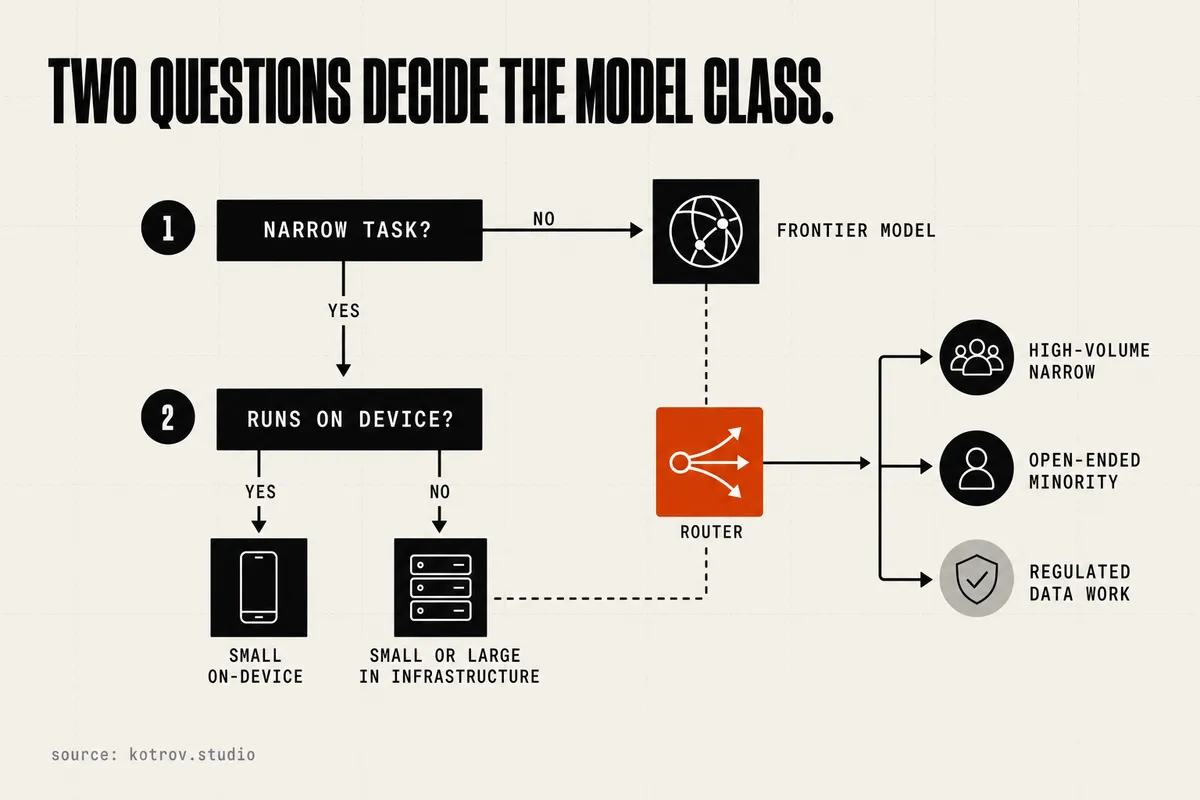
What you build from that is a heterogeneous system: small specialists on the narrow, high-volume, on-device nodes, a frontier model held for the open-ended minority, and a router between them you treat as a real component with its own reliability budget.
Half the load-bearing numbers in this argument moved in under two years, and one of the most-quoted reversed outright. The 8B-beats-GPT-4 tool-calling result was true, then wasn’t, and it will keep circulating for years because nobody re-checks a fact that flatters their architecture. Put a date on every benchmark you build on, and re-run the ones your design depends on before you renew the contract.
The one line no model release will move is the memory arithmetic. A 70B model needs about 35GB of VRAM even at INT4, and no phone has it. Every benchmark gap in this piece is a moving target. That one is a wall.
References
- NVIDIA — “Small Language Models are the Future of Agentic AI,” arXiv 2506.02153 (HTML)
- Predibase — “LoRA Land: 310 Fine-tuned LLMs that Rival GPT-4,” arXiv 2405.00732
- Microsoft — Phi-4 Technical Report, arXiv 2412.08905
- Google DeepMind — Gemma 3 Technical Report, arXiv 2503.19786 · Gemma 4 Technical Report, arXiv 2607.02770
- Apple Machine Learning Research — Third-generation Apple Foundation Models · Introducing Apple’s On-Device and Server Foundation Models
- Google — Gemini Nano on Android
- Microsoft Learn / Azure AKS — Concepts: Small and Large Language Models
- Gorilla / Berkeley Function Calling Leaderboard (v4)
- “RouteLLM: Learning to Route LLMs with Preference Data,” ICLR 2025, arXiv 2406.18665
- “Small Language Models for Agentic Systems: A Survey,” arXiv 2510.03847
- “Small Models Struggle to Learn from Strong Reasoners,” arXiv 2502.12143
- “Understanding Parametric Knowledge Injection in RAG,” arXiv 2510.12668
- Vendor pricing, accessed 2026-07-16 — OpenAI · Anthropic · Google Gemini
- EU AI Act — regulatory framework overview
- Mayo Clinic / Med-PaLM 2 — Healthcare Dive
- VRAM requirements — DatabaseMart 7B/70B guide
- Seed source — ByteByteGo, LLMs vs SLMs
WEEKLY NOTE
One note per week.
One short note from current work plus 2–3 outside links worth your time.

Oleksandr Kotliarov
Founder · Engineering Lead · Kraków, Poland
I build engineering teams that ship — from MVP to Series A delivery.