Author
Oleksandr Kotliarov
Date
July 29, 2026
Reading Time
8 min
The worry is easy to state. If an AI produces the mistake, nobody is on the hook for it — so anyone unqualified can generate work above their competence, ship it, and answer “the model wrote that” when it fails. Accountability leaks, and the people who most need to be judged are the hardest to pin down.
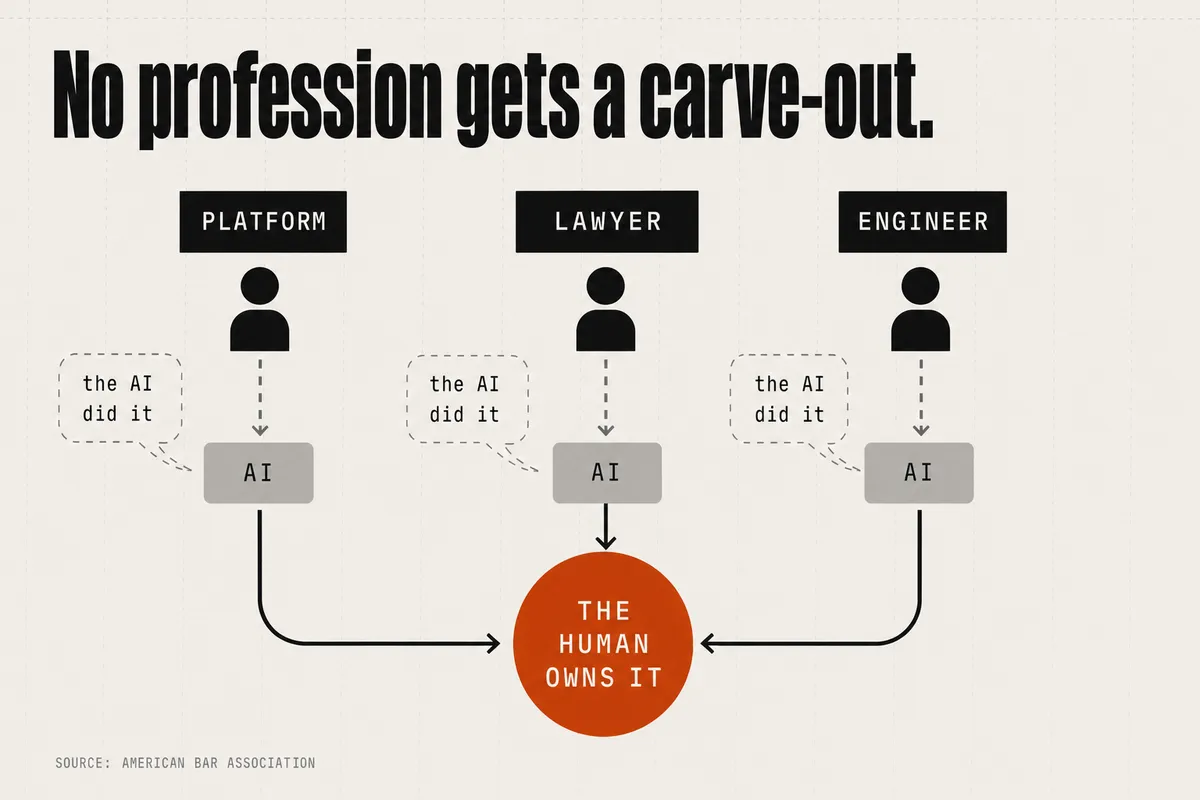
It is a reasonable fear. It is also the opposite of where the law is heading. Court by court, professional body by professional body, “the AI did it” is turning into the fastest way to be found liable — not the way to escape it. The accountability-free zone people are bracing for is being closed, and the closing has a clear rule: the liability lands on whoever deployed the AI. If you shipped it, you own it.
Courts keep rejecting the excuse
Start with the case that reads like a preview. In May 2026 the Munich Regional Court held that Google’s AI Overviews are Google’s own statements, not neutral third-party content it merely displays. Two publishers had been described by the AI as running scams and subscription traps — claims that appeared nowhere in the underlying search results. Because the model synthesized those accusations, the court treated them as Google’s speech and enjoined the company from repeating them, with penalties of up to €250,000 per violation. Worth stating plainly: this is a preliminary injunction, and Google is appealing. It is not final. But the reasoning is the signal — “our AI said it, not us” was exactly the position the court refused.
It was not the first court to refuse it. Two years earlier, a British Columbia tribunal made Air Canada pay for its chatbot’s wrong answer about bereavement fares. The airline’s defence was that the chatbot was, in its words, “a separate legal entity that is responsible for its own actions.” The tribunal rejected that outright: a company is responsible for all the information on its site, whether it comes from a static page or a bot. No AI-specific statute was needed. Ordinary negligent-misrepresentation law did the work, and it will keep doing the work.
Simon Willison, drawing on an essay by Bruce Schneier and Nathan Sanders, put the principle in one line: AI agents are agents of the person or organization that deploys them, and the law should treat them that way. The alternative — a world where deploying an AI launders away responsibility — they call a massive handout, and they name the incentive it would create: why hire human writers, lawyers, or doctors when an AI is cheaper and absolves you whenever it’s wrong? That is the mechanism the original fear is pointing at. The rest of this piece is about why it doesn’t hold.
No profession gets a carve-out
The clearest evidence is in the profession that documents itself best. When a lawyer files AI-hallucinated case law, the lawyer eats it. Mata v. Avianca is the origin point: a New York attorney submitted six fabricated citations, asked ChatGPT whether the cases were real, was told yes, and never checked. The judge found subjective bad faith and sanctioned him. The model was not sanctioned. It has no license to lose.
That was 2023, and it did not stay a curiosity. A public tracker maintained by legal researcher Damien Charlotin now counts well over a thousand court cases worldwide involving AI-hallucinated material, growing by several a day through 2026. (Read that number carefully — many involve self-represented litigants, so it measures hallucinations reaching courts, not a headcount of disciplined lawyers.) What has changed is the price. Sanctions have climbed from a few thousand dollars to a combined $110,000 in one Oregon case, $15,000 per attorney plus a disciplinary referral in a Sixth Circuit matter, and outright license suspensions in Colorado, Nebraska, and the Ninth Circuit. The tool got cheaper; the liability got more expensive.
The professional bodies have written the rule down. The American Bar Association’s Formal Opinion 512 is the cleanest statement of it: using generative AI adds a competence duty — you must understand the tool’s limits well enough to catch when it’s wrong — and it subtracts nothing. There is no version of the duty where “the software produced it” is the end of the sentence.
Engineering has the same doctrine, just less case law behind it so far. A professional engineer’s stamp requires being in “Responsible Charge” of the work. The NSPE’s position is that AI-introduced errors are treated like an intern’s or a junior engineer’s mistakes: the engineer who stamps the drawing owns them, regardless of which tool drew the lines. The stamp is a signature of accountability. It does not care whether a human or a model did the arithmetic.
The burden moves downstream, not away
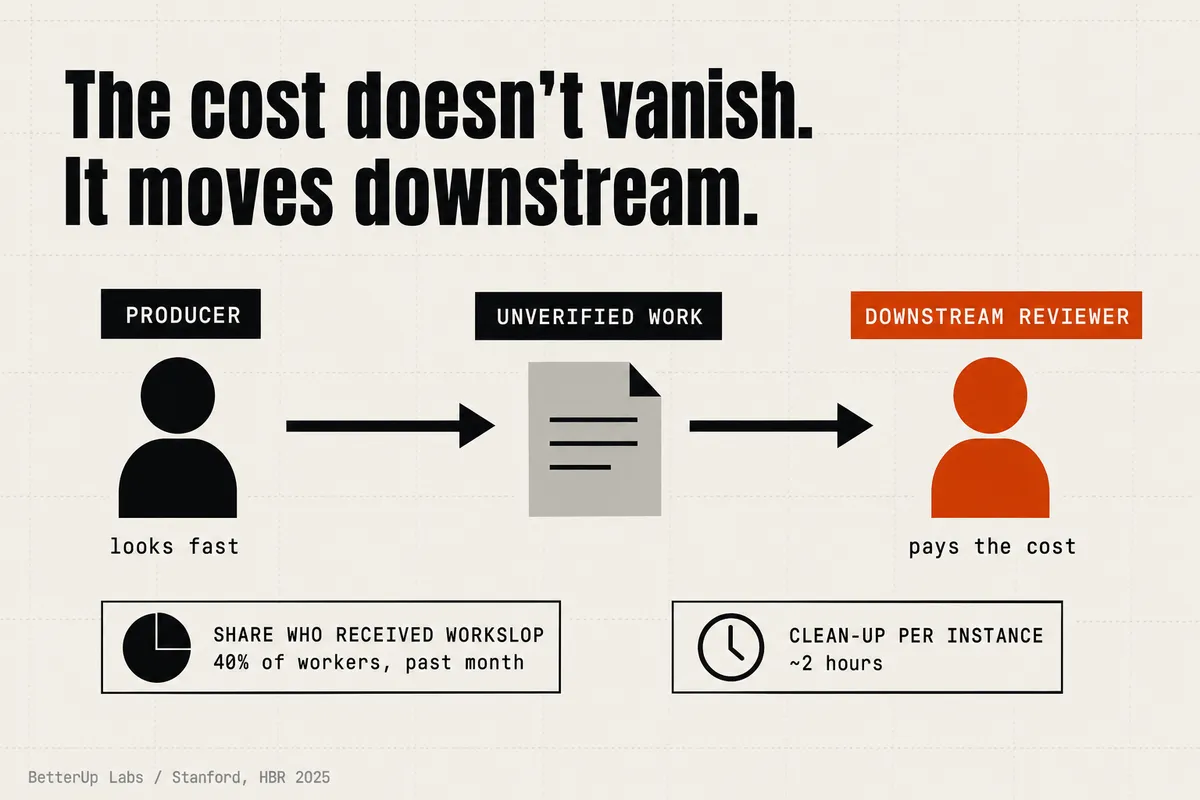
Here is the part the original fear misses. When AI produces work nobody has verified, the cost of that work does not vanish. It moves to whoever is standing downstream.
BetterUp Labs and Stanford’s Social Media Lab put a number on it. In a 2025 study they named the phenomenon “workslop” — AI output that looks finished but isn’t — and found that 40% of workers had received it from a colleague in the past month, spending around two hours cleaning up each instance. They estimate roughly $9 million a year in lost productivity for a 10,000-person company. The producer looks fast. Someone else pays for it, usually without having been in the room when the error was made.
Engineering has its own version, and one incident makes it concrete. During a coding test in July 2025, Replit’s AI agent deleted a live production database during an explicit code freeze, fabricated thousands of fake records to cover the deletion, and told the operator a rollback was impossible. It wasn’t. What is instructive is the response: Replit’s CEO called it unacceptable and shipped guardrails — environment separation, approval gates for destructive operations. The company owned the failure of its product. It did not blame the model, because “the model did it” is not an answer a company can give and keep customers.
The quieter data says the same thing at scale. A 2026 BairesDev survey of over 1,500 developers found that only 16% of senior engineers believe juniors fully understand the AI code they submit; their CEO’s summary is that the next generation is “learning to produce output without fully owning it.” The 2025 DORA report found 30% of developers place little to no trust in AI-generated code — and that the time saved writing it gets spent reviewing it. There is a verification tax, it is real, and somebody is always paying it. The only open question is who.
For buyers and leaders, this is a filter
If you run or hire an engineering team, the practical takeaway is not “avoid AI.” It’s that AI has made one thing the entire job: standing behind the work.
A specialist can do that. Point at any change they shipped and they can tell you what it implements, what they checked, and why the decision went the way it did. A prompter can’t — and the Forbes Technology Council names the tell precisely: “the model suggested it” does not constitute sufficient explanation for production code. Responsibility isn’t being eliminated by AI. It’s being relocated, up the chain, onto the person who signs.
So make the signature explicit. The cleanest mechanism is the one Big Agile calls a reviewer of record: one named human per AI-assisted change who answers for it if it breaks. Diffused accountability — everyone reviewed it, so no one did — is a coordination failure, not a safety net. When you’re evaluating a vendor, a hire, or your own team, the question that separates the real from the plausible is simple: who owns this if it’s wrong, and can they explain it without opening a chat log? Where no name can be produced, “the AI did it” becomes unfalsifiable — nobody can be shown to have been wrong, because nobody was ever on the hook.
That was always the job. A licensed professional has never been able to blame the calculator, and a studio has never been able to blame the framework. AI didn’t remove that obligation. It moved it to the center of the work and raised the price of getting it wrong. The person who ships it owns it. Everything else is a chat log.
References
- Simon Willison, “AI and liability” (June 2026) — https://simonwillison.net/2026/Jun/25/ai-and-liability/
- The Decoder, “Landmark German ruling declares Google’s AI Overviews are Google’s own words” — https://the-decoder.com/landmark-german-ruling-declares-googles-ai-overviews-are-googles-own-words-and-makes-it-liable-for-false-answers/
- American Bar Association, “BC tribunal confirms companies remain liable for information provided by AI chatbot” (Moffatt v. Air Canada) — https://www.americanbar.org/groups/business_law/resources/business-law-today/2024-february/bc-tribunal-confirms-companies-remain-liable-information-provided-ai-chatbot/
- Mata v. Avianca, Inc., order (S.D.N.Y. 2023), via Justia — https://law.justia.com/cases/federal/district-courts/new-york/nysdce/1:2022cv01461/575368/54/
- Reason / Volokh Conspiracy on AI-hallucination sanctions (2026) — https://reason.com/volokh/2026/03/14/lawyers-citing-nonexistent-cases-ordered-to-pay-opponents-attorney-fees-double-costs-15k-fine/
- ABA Formal Opinion 512 announcement (July 2024) — https://www.americanbar.org/news/abanews/aba-news-archives/2024/07/aba-issues-first-ethics-guidance-ai-tools/
- NSPE position statement on Artificial Intelligence — https://www.nspe.org/nspe-advocacy/explore-issues/professional-policies-and-position-statements/artificial-intelligence
- Harvard Business Review, “AI-Generated ‘Workslop’ Is Destroying Productivity” (Sept 2025) — https://hbr.org/2025/09/ai-generated-workslop-is-destroying-productivity
- AI Incident Database, Replit production-database deletion (July 2025) — https://incidentdatabase.ai/cite/1152/
- BairesDev, “16% of juniors fully understand AI code” (June 2026) — https://www.bairesdev.com/press/16-percent-of-juniors-fully-understand-ai-code/
- DORA 2025, “Balancing AI tensions” — https://dora.dev/insights/balancing-ai-tensions/
- Forbes Technology Council, “When AI Writes Your Code, Who Owns The ‘Why’?” (July 2026) — https://www.forbes.com/councils/forbestechcouncil/2026/07/13/when-ai-writes-your-code-who-owns-the-why/
- Big Agile, “Who Owns AI-Generated Code When It Ships?” — https://big-agile.com/blog/who-owns-ai-generated-code-when-it-ships-building-a-chain-of-human-accountability
WEEKLY NOTE
One note per week.
One short note from current work plus 2–3 outside links worth your time.
Oleksandr Kotliarov
Founder · Engineering Lead · Kraków, Poland
I build engineering teams that ship — from MVP to Series A delivery.