AI didn't replace engineers. It moved the demand to verification.
Author
Oleksandr Kotliarov
Date
July 24, 2026
Reading Time
24 min
AI didn’t reduce the demand for engineers. It moved the demand from producing code to verifying it, and verification is senior work. That one shift explains both halves of the 2026 data: the resilience everyone quoted, and the entry-level collapse almost nobody did.
Start with the reassuring half, because it is real. SignalFire’s State of Talent Report 2026 names the fear directly — it calls it “The AI Code Apocalypse” — and says the last 15 months of hiring data show it “has failed to materialize.” Across the twelve companies it tracks as Tech Majors, total hiring is down 25% against 2019 while engineering headcount is down only 11%. Design fell 48%. Product management fell 39%. Marketing fell 36%. Engineers are now 55% of all new hires at those companies, up from 46% in 2019. At early-stage startups the divergence is sharper: engineering headcount grew 7% against 2019 while design shrank 22% and marketing shrank 18%.
If you had to pick one white-collar function to survive the cost-cutting inside well-funded tech, you would have picked the engineer, and you would have been right. The bet on the engineer paid.
Now read the next line of the same report. New-grad hiring at those same twelve companies is down 65% against 2019, and down 76% at early-stage startups. Same dataset. Same page. The function held and the on-ramp closed, and those two facts have been circulating for a month as though they were unrelated.
They are not unrelated. They are the same mechanism seen from two ends.
The aggregate is composite
“Engineering is resilient” is an average, and this particular average is doing a lot of concealing. Three separate things are folded into it, and each one has to come out before the number means anything to a person making a hiring plan.
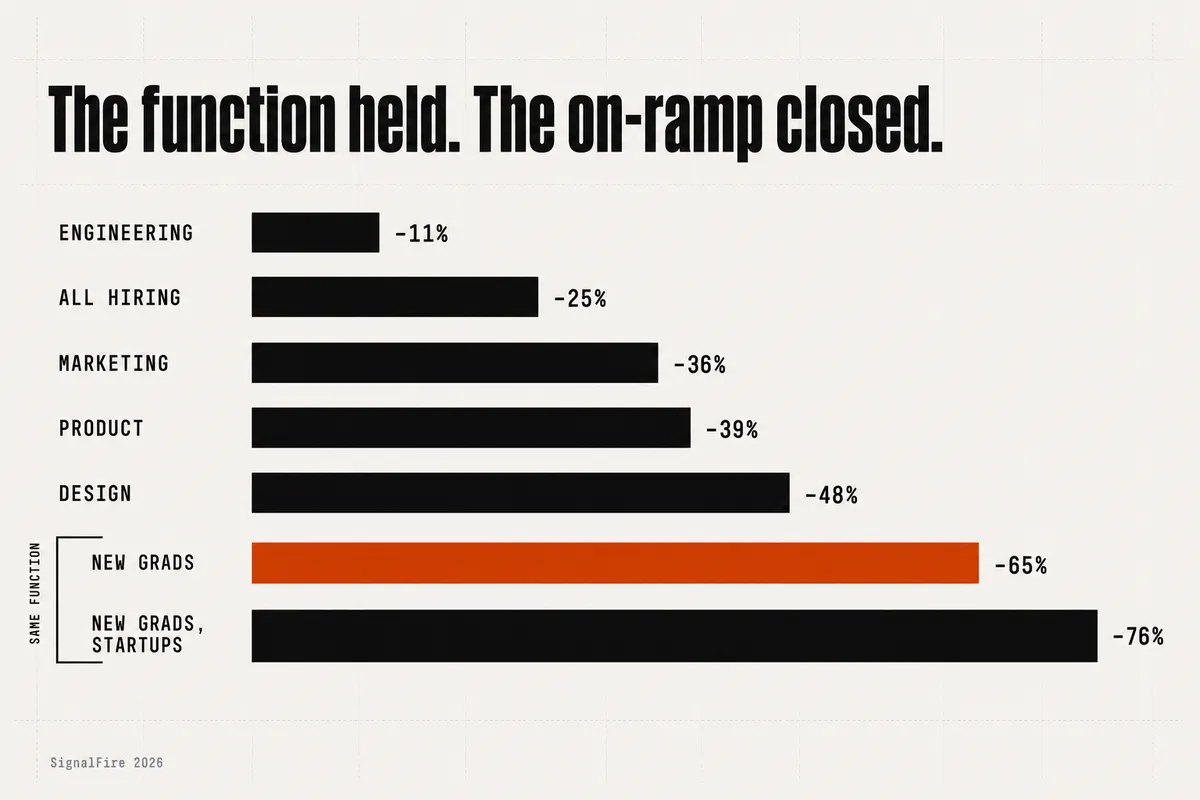
Seniority. The -11% is a headcount figure across all levels. The -65%/-76% new-grad figure is the same population sliced by experience. A function can hold its headcount while completely changing which humans it is willing to buy — and that is what the two numbers together describe. Whatever is protecting engineering is not protecting people who have never done it professionally.
Specialization. Some of “engineering held up” is really “one kind of engineering exploded.” In the same SignalFire data, AI/ML engineer hiring is up 39% since ChatGPT launched and research-engineer hiring is up 28%, while front-end engineering is down 25%. Ravio’s European dataset reports AI/ML hiring up 88% year-over-year, with a 12% pay premium on the IC track. An AI-role boom is sitting on top of real generalist softness and pulling the aggregate up with it. “Engineer” is not one labor market, and the strength of the composite tells you very little about the market you are actually hiring in.
Absolute level. Resilient means resilient relative to design and marketing, not back to 2021. Tech job postings finished 2025 roughly 35% below pre-pandemic levels, in what Indeed’s economists call a low-hire, low-fire market — employers cautious enough to stop hiring, not alarmed enough to run mass layoffs. Engineering is the best seat in a room that got considerably smaller.
Two more numbers get quoted into this gap, and both deserve to be pushed back out of it.
The first is the BLS projection of 15% growth for software developers through 2034. It is a ten-year occupational projection. It is not a measurement of 2026, it cannot confirm anything about 2026, and citing it as evidence that the current market is fine is a category error.
The second is AI-related postings growth. Indeed’s own July 2026 analysis of the data-center build-out is the corrective: the ten largest tech companies by market cap account for 71% of data-center job postings this year, concentrated in construction, installation, and maintenance roles that pay less than software engineering. Over the same period the information sector’s layoff rate rose from 1.2% to 1.8% year over year, and tech led all sectors in 2026 layoff announcements. A real share of “AI is creating tech jobs” is physical infrastructure work. Those are jobs. They are not engineering headcount, and nobody should be counting them as such.
Strip the three layers out and the reassuring headline resolves into something narrower and more useful: senior and AI-adjacent engineers are in demand, generalist and junior engineers are not, and the aggregate is being carried by the first group while the second group quietly leaves the dataset.
One source, two bylines
A note on provenance, because it matters more than usual here.
The story reached most people through TechCrunch’s June 24 write-up, which is built almost entirely on the SignalFire report. That is one source with two bylines. It is not two sources agreeing, and “multiple reports confirm engineering is resilient” is a sentence nobody is entitled to write. SignalFire is a venture firm, its dataset is proprietary, its Beacon platform is described as tracking 650+ million individuals and 80+ million organizations, and none of us can audit any of it. The report may well be right. It is still unreplicated.
Which makes the honest position asymmetric, and the asymmetry runs against the comfortable half of the story. The top-line resilience number has no independent corroboration. The junior collapse has plenty.
Ravio, working from European compensation-benchmarking data covering 400,000+ employees across 1,500+ companies, finds entry-level (P1/P2) hiring down 73.4% year over year. Different continent, different method, different sample, same shape. And carry Ravio’s own framing rather than the one that flatters this thesis: they find juniors hit hardest across People, Marketing, and Engineering. Their pattern is junior-broadly, not engineering-specifically — a hint about causation we come back to later.
Stanford’s Digital Economy Lab goes further than hiring rates. Its Canaries in the Coal Mine paper — first posted November 13, 2025, revised February 9, 2026 — uses ADP payroll microdata, the records of the largest US payroll provider, and finds a 16% relative employment decline for workers aged 22–25 in the most AI-exposed occupations, controlling for firm-level shocks. Employment for experienced workers in the same occupations held flat.
That is a different and worse claim than a hiring slowdown. A slowdown means the door narrowed. A relative employment decline means the population is shrinking against its own comparison group: people are not entering, and some are leaving. It comes from payroll records rather than a recruiter’s view of twelve companies, and it is the most methodologically independent number in the pile.
Three datasets, three methods, two continents, one agreement — the entry level is closing. That finding is solid. The reassuring headline next to it rests on one vendor’s data. Weight them accordingly.
The demand moved from production to verification
Here is the part the rest of the commentary skipped. If you want one mechanism that produces both halves of the data, it is this: AI made producing code dramatically cheaper without making the acceptance of code any cheaper at all. Production stopped being the constraint. Verification became the constraint. And verification is the part of the job that requires having already been an engineer for a while.
That claim has to survive the evidence, so take the evidence in order.
Individual speedups are real, contested, and wildly heterogeneous
The productivity literature is usually cited as if it were a chorus. It isn’t.
Google ran a proper RCT — 96 engineers, a realistic task on internal infrastructure — and found the AI-assisted group 21% faster. Take the number with the authors’ own caveats attached: the confidence interval is wide, and the benefit concentrated in senior developers and those who write code for more hours a day. That heterogeneity is not a footnote. It is the finding. The tool amplified people who already had judgment.
The famous “55% faster” figure is real but is not what most people think it is. It comes from Peng et al., 2023 — 95 developers, one scoped lab task (implement an HTTP server in JavaScript), pre-GA Copilot — and the measured gain was 55.8% on that task. It is a lab result on a toy problem. It is routinely, and wrongly, attributed to the GitHub×Accenture study, which is a different piece of research entirely. The actual Accenture study — a real deployment inside a real engineering org, May 2024 — reports +8.69% pull-request volume, +15% merge rate, +84% build success. No completion-time figure appears in it. If you have been repeating “GitHub/Accenture found 55% faster,” you have been merging a lab number onto a field study, and the field study is six times less impressive.
Then there is the result that points the other way, and it is the best-designed study in the set. METR’s July 2025 RCT took 16 experienced open-source developers working on 246 real issues in repositories they knew intimately — 22,000+ stars, 1M+ lines of code — randomized at the task level, pre-registered. AI made them 19% slower. They forecast a 24% speedup beforehand. Afterwards, having just been slowed down, they still reported feeling 20% faster. That is roughly a 39-point gap between perception and measurement, in exactly the population whose intuition everyone trusts.
METR is careful about what this does and doesn’t mean, and so should we be: they do not claim AI fails to speed up most developers, and they flag that mature, familiar, high-quality codebases may be a special case. But their February 2026 follow-up is the more interesting artifact. They tried to re-run the study and the design collapsed. Developers now refuse to be randomized into the no-AI condition even at $50/hour; 30–50% reported steering away from tasks they thought AI would handle well. Their central late-2025 estimate is, in their own words, “likely a bad proxy for the real productivity impact of AI tools.” The organization that ran the cleanest experiment on this question now says a clean answer may no longer be measurable, because the population willing to work without AI has become too self-selected to generalize from.
Rudi Kershaw’s synthesis of the literature lands about where the evidence lands: “It’s not 100 times faster. It’s not 10 times faster. As far as the evidence is concerned, it is not even twice as fast.”
The gains translate to the organization badly, and unevenly
Individual speed is not org output, and DORA has the cleanest longitudinal read on the gap. In the 2024 report, a 25-point increase in AI adoption was associated with -1.5% delivery throughput and -7.2% delivery stability — worse on both, while roughly three-quarters of individuals reported feeling more productive. In the 2025 report, fielded across nearly 5,000 practitioners, the throughput relationship flipped positive. The stability relationship did not. It stayed negative in both years, even as adoption climbed to around 90%.
DORA’s own framing is that “AI accelerates software development, but that acceleration can expose weaknesses downstream” — absent strong controls, more change volume produces more instability.
One year of reversal is not a trend. The precise claim is this: individual gains were not reaching the organization at all through 2024, they have started to in the most recent survey, and the instability cost has not gone away in any year measured.
The keystone: production got cheap, verification did not
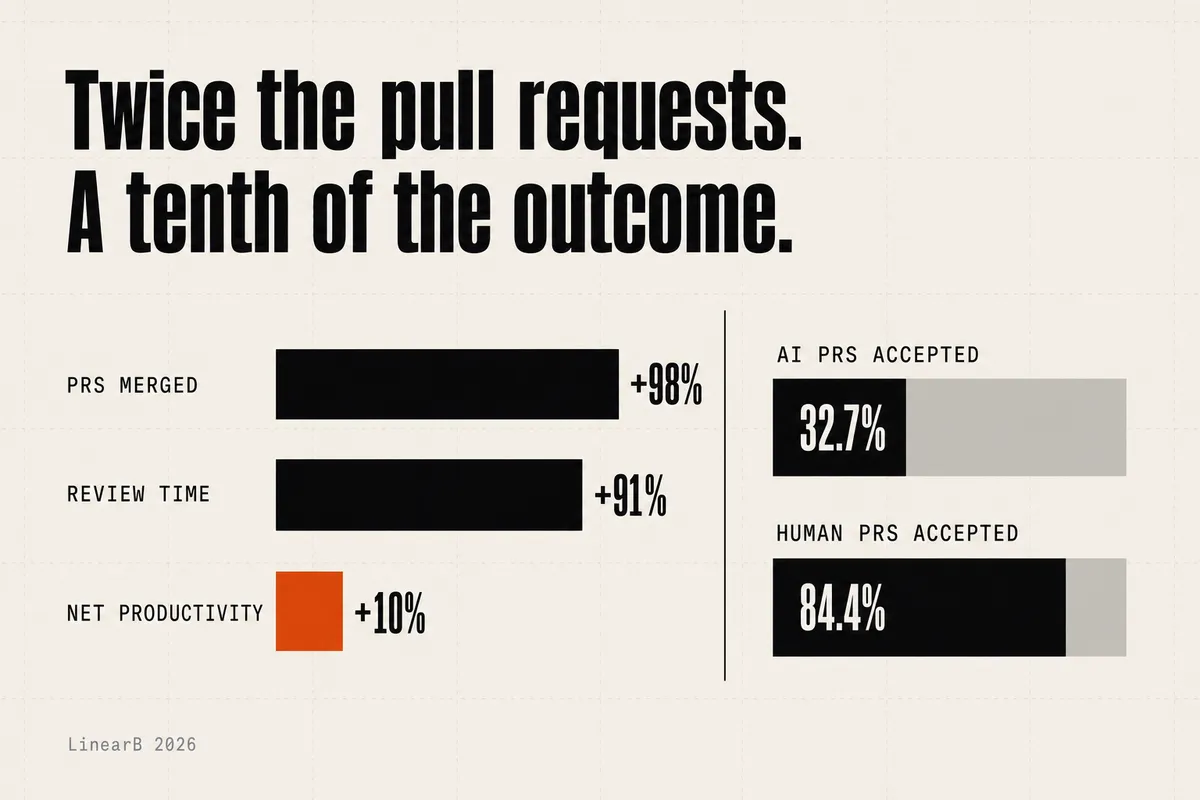
LinearB’s 2026 benchmarks analyze 8.1 million pull requests across 4,800+ organizations, and they are the clearest picture anyone has of what happens when a team turns AI on:
- Teams with high AI adoption merged 98% more PRs.
- Total review time rose 91%.
- Net organizational productivity improvement: about 10%.
- AI-authored PRs are 2.6x larger than human ones — 408 lines against 157.
- AI-authored PRs wait 4.6x longer for a reviewer to pick them up.
- AI-authored PRs are accepted at 32.7%. Human-written PRs are accepted at 84.4%.
Sit with the last two lines. Roughly two-thirds of AI-generated pull requests never merge — and every one of them still consumed queue position, reviewer attention, and senior judgment on the way to being rejected. The team doubled its output of the thing it measures and bought roughly a tenth of the outcome it wanted. What it actually bought was a queue.
LinearB sells engineering-metrics tooling, so flag the vendor interest. But the PR-level dataset is large and specific, and the surrounding evidence is consistent. Sonar’s January 2026 developer survey reports AI now writing 42% of committed code, 96% of developers saying they don’t fully trust that code to be functionally correct, 61% agreeing it “often produces code that looks correct but isn’t reliable,” and only 48% saying they always verify it before committing. 38% say reviewing AI code takes more effort than reviewing a colleague’s. Even the most favorable 2026 field data carries the same asterisk: Microsoft’s study of its early-2026 CLI-agent rollout across tens of thousands of engineers found adopters merged about 24% more PRs, and the authors state plainly in the abstract that “a merged pull request is not the same as the value it delivers.”
Rick Pollick’s summary of the dynamic is the shortest correct statement of it we’ve found: “Generation got cheap. Verification did not.”
Why that reshapes the hiring plan
Follow the incentive through. If code production is cheap and abundant, and the binding constraint on shipping is the review queue, then the marginal hire who improves throughput is the one who can clear that queue: someone who can read 400 lines of plausible-looking generated code and tell you which third of it is wrong, why it will page you at 3am, and what it does to the system boundary it just crossed.
That is not a task you hand to a new graduate. It is the definition of senior work.
So a firm behaving rationally hires more people who can verify and fewer who can only produce — because production is the thing it just got for free, and because every additional producer now adds load to the constraint instead of relieving it. The same mechanism generates both numbers on SignalFire’s page. Engineering headcount holds, because the verification work is real, growing, and human. The entry level collapses, because the entry level is where the production work lived.
That is the argument. It is a mechanism, not a proof — no study connects “AI made this engineer 21% faster” to “therefore this company hired one more senior and one fewer junior.” Every dataset here covers one link in the chain. But it is the only story we’ve found that produces both halves of the data from one cause, and the alternatives require two findings in the same report to be a coincidence.
Why Jevons is the wrong reach
The optimistic counter-argument is Jevons paradox: cheaper software production means more software gets built, which means more engineers are needed to design and direct the larger surface. Cheaper coal meant Britain burned more coal, not less.
It deserves a fair statement, because it has serious proponents. Torsten Slok, chief economist at Apollo Global Management, has built what he calls the Jevons employment effect around exactly this: “When steam engines made coal more efficient, Britain didn’t burn less coal, it burned more. The same pattern is happening for cheaper legal services, consulting services and financial services.” Note precisely what that is and isn’t. It’s a claim about professional services broadly. It’s not a claim about software engineering, and the same reporting that carries the argument lists the entry-level collapse as its direct counter-evidence.
The problem with Jevons here is not that it’s wrong. It’s that it answers a question nobody asked.
Jim Rutt’s treatment of the paradox for software makes the necessary split explicit: the paradox can hold for software volume while breaking completely for developer jobs, because what changes is the identity of who produces the software. Total output rising says nothing about engineering employment unless demand expands faster than productivity does — and Rutt, arguing the optimist side, concedes that not all current developers transition into the architecture-and-judgment work that stays scarce.
Stephan Schmidt puts the pessimist version of the same split more sharply: “The resource is not developer hours. The resource is ideas, the engine is the dev department, and AI is shrinking the engine faster than rising demand can grow it.” His mechanism is that the new software is increasingly built by people who are not engineers and were never going to hire one.
Then there’s the parable underneath the whole optimist case, which turns out to be load-bearing and unsound. Everyone reaches for ATMs: automation cut tellers per branch from ~21 to ~13, yet total teller employment grew, because cheaper branches meant banks opened more of them. David Oks’s reconstruction of that history argues the offsetting force was never automation-created demand — it was 1980s–90s interstate banking deregulation, which triggered a branch-opening boom that would have happened anyway. Tellers per branch fell steadily from 1985 onward, exactly as any economist would predict. The aggregate headline depended on an unrelated policy tailwind. Paul Kedrosky’s independent read converges on the same conclusion. And when automation eventually graduated from doing some of the teller’s tasks to doing nearly all of them — mobile banking — the teller decline arrived on schedule.
Oks leaves the useful question behind: “unless you can identify the offsetting force, job survival may be coincidence rather than mechanism.”
So name the offsetting force for software in 2026, the way Oks names deregulation for banking. We can’t. Nobody in this research can. That isn’t a reason to conclude the pessimists are right. It’s a reason to stop treating “Jevons will save us” as an argument rather than a hope with a 160-year-old costume on.
Nobody can tell you how much of this is AI
Everything above assumes the entry-level collapse has something to do with AI. That assumption is doing a lot of work, and it is genuinely contested by people with better data than ours.
The New York Fed published a study on June 1, 2026 — Emanuel, Harrington, and Pallais — finding that remote work explains 64% of the recent increase in unemployment among young college graduates. Their method is CPS data comparing a 2017–19 baseline against 2022–25, contrasting “remotable” occupations (software engineering is their lead example) against non-remotable ones. Their mechanism is mentorship: remote work makes junior employees harder to train, harder to evaluate, and harder to justify. Their words on the rival explanation are not hedged: “the uptick in youth unemployment rates predates the rapid diffusion of AI,” and “the timing of this surge suggests that remote work — not generative AI — explains the bulk of the rise in youth unemployment.” They add that when they hold AI exposure constant, the age gap persists.
Hold that against Stanford. Two serious institutions, two primary datasets, two “primary driver” claims about the same symptom. They cannot both be the bulk of the same effect.
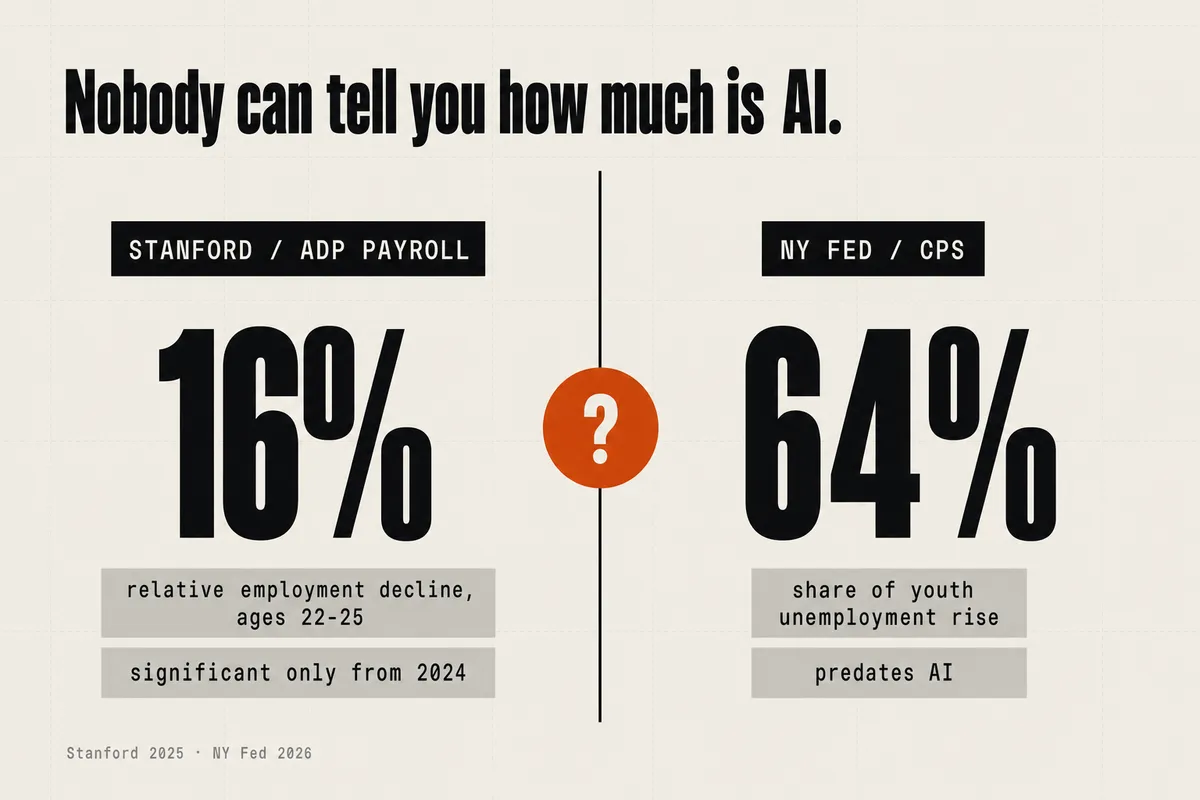
And Stanford’s own authors have narrowed their claim in a way that helps the NY Fed. Their February 2026 follow-up reports that with the broadest set of controls — firm-time fixed effects — the AI-attributable decline becomes statistically significant only from 2024 onward. The late-2022 and 2023 declines, the ones right after ChatGPT shipped and the ones most often waved at as proof, are “likely (at least partly) due to some combination of other factors, not just AI.” They say directly: “we do not believe that AI is always and everywhere the sole determinant of employment.” The same note tests the interest-rate hypothesis against an occupation-level rate-sensitivity crosswalk and reports it doesn’t fit — AI-exposed occupations are less rate-sensitive on average, with construction as the obvious counterexample.
Two more candidate explanations deserve to be scoped rather than dismissed.
Section 174 is real and mostly finished. The R&D amortization change hit tax years starting after December 31, 2021, is credibly tied to the 2022–2024 layoff wave, and was substantially repealed for domestic R&D in July 2025 — foreign R&E still amortizes over 15 years, which keeps a live incentive to offshore. But it belongs to 2022–2024. It does not explain a 2025–2026 entry-level squeeze, and the most serious industry treatment of it is itself skeptical it drove even its own window: “I am not so sure this is the case: the end of ZIRP is more likely in my view.” Keep the windows separate. Over-crediting the tax code is the same error as over-crediting AI, pointed the other way.
Offshoring gets invoked constantly and has, as far as we can find, no citable number attached to it for junior engineering specifically. Treat it as a plausible contributor, not a verified explanation.
Then there is the measurement problem underneath all of it. Torsten Slok — the same economist making the Jevons case — notes that five competing AI-exposure measurement frameworks are in current use, some built on observed tool usage, some on theoretical task-capability assessments, and that “the five measures disagree most exactly where the stakes are highest”. The entry-level question is precisely where the field’s instruments are least settled. That is also the backdrop against which 200+ economists and 16 Nobel laureates, including former displacement skeptics Daron Acemoglu and Simon Johnson, signed a statement on July 13 warning of economic transformation “larger than the Industrial Revolution… unfolding over a vastly shorter time frame.” That statement is about macro risk, not junior engineers — cite it as evidence that concern is broadening among former skeptics, nothing narrower.
We are not going to resolve this, and neither is anyone else writing about it this month. The defensible claim is smaller than either camp’s: something is closing the entry-level door, AI is a credible part of it from 2024 onward, and the split between AI, remote work, and the end of cheap money is not settled. Anyone who tells you it is has something to sell.
Notice that the verification mechanism survives either reading. If AI moved the work from production to verification, the entry level suffers. If remote work made juniors impossible to mentor, the entry level suffers. Both stories end with the same door closing, which is why the door is worth planning around even while the cause stays open.
The skill the market wants is the one AI erodes
Here is the closing tension, and it is genuinely uncomfortable.
Verification judgment is now the scarce, expensive thing. The way humans have always acquired it is by producing work badly, getting it rejected, and finding out why. Anthropic ran a randomized trial on exactly that mechanism and published it on January 29, 2026: 52 mostly-junior engineers learned an unfamiliar async library, half with AI assistance, half by hand. The AI-assisted group scored 50% on a mastery quiz. The hand-coding group scored 67% — a gap of nearly two letter grades, Cohen’s d = 0.738, p = 0.01. They finished about two minutes faster, a difference that wasn’t statistically significant. The largest gap was on debugging questions.
Read that against the LinearB numbers. The market is repricing toward debugging judgment, and the tool that made the market do that appears to suppress the formation of debugging judgment. One study, n=52, one company, one library — cite it as the first real experimental data point for a decades-old prediction from cognitive apprenticeship and deliberate-practice research, not as settled science.
Now the counters, honestly, because they’re real.
The strongest is Brynjolfsson, Li and Raymond’s study of 5,179 customer-support agents, NBER working paper 31161, published in the QJE. Generative AI assistance raised productivity 14% on average and 34% for the least-experienced workers, with near-zero effect for experienced ones. AI compressed the experience curve rather than hollowing it out. The reconciliation with Anthropic’s result is the most defensible claim available on this whole question: AI transmits procedural, retrievable expertise well — what experienced people say, which patterns they reach for — and appears to suppress generative, debugging judgment, the kind built by tracing why an unfamiliar system broke. Not “AI helps” or “AI hurts.” Different skills, opposite signs.
Companies have split accordingly, and the split has names on it. Anthropic’s own co-founder Jack Clark said in June 2026 that they’re hiring more experienced people and skipping entry level “because the returns on intuition are much greater than before.” The company that produced the best evidence that AI erodes junior skill formation is also the company acting as though juniors are unnecessary. Both things are true; neither is a lie; that is what an unresolved question looks like from the inside.
Against them: IBM’s CHRO Nickle LaMoreaux said in February that they are tripling US entry-level hiring, “and yes, that is for software developers and all these jobs we’re being told AI can do,” naming a mid-level manager shortage in three to five years as the risk she’s hedging. Shopify grew its internship program from roughly 100 to over 1,000, and its head of engineering, Farhan Thawar, is refreshingly unwilling to claim he’s solved it: “The honest answer is: we don’t know. No one has really figured out yet what it means to evaluate the next generation of technical talent with these tools.” And Ramp’s economics team, linking corporate-card AI spend to workforce records across 21,559 US firms, found high-intensity AI adopters grew entry-level headcount +12% and total headcount +10.2%. Their own caveat is as load-bearing as the finding: those firms were “already larger, more engineering-intensive, more likely to be venture-backed, and faster-growing than non-adopters” before they adopted anything. It’s correlational, from a vendor whose product is AI spend, on an atypical slice of already-hot companies. It is still the best direct counter-evidence in existence, and it deserves to be stated rather than buried.
The precedents don’t rescue anyone either. The closest match — machinists — shows a broken apprenticeship pipeline producing a shortage that has persisted for forty years, but it broke from industrial decline and offshoring, not from automation eating the junior tasks. And radiology is the clean counter-example, the one that should keep this piece honest. Geoffrey Hinton said in 2016 that people should stop training radiologists, that within five years deep learning would obviously do it better. The field ignored him. Residency slots grew nearly every year and hit a record 1,208 positions in 2025. Radiology is short-staffed today — 4,000+ open roles, salaries around $571,000 — for demand reasons that have nothing to do with a cut pipeline. The warning was right about the capability and wrong about the consequence, and the field’s protection was that it declined to act on the prediction.
No clean precedent exists in either direction. That absence is the finding.
What to do Monday morning
If you lead engineering at a Series A, the data supports four specific moves and does not support “stop hiring juniors.”
Price the roles as three markets, not one. Senior generalist, AI-adjacent specialist, and junior are three different supply curves with three different clearing prices. A -11% aggregate and a +39% AI/ML line and a -25% front-end line are all in the same report. Budgeting against the average will overpay in the soft market and underbid in the tight one.
Measure review capacity, not merge volume. This is the one that costs money right now. If AI doubled your PR count and your review time went up 91%, you bought a queue and called it velocity. Instrument the constraint: time-to-first-review, review load per senior, and the merge rate of AI-authored PRs specifically. If two-thirds of them never land, that queue time is pure loss and it’s being paid for in your most expensive people’s attention.
Hire juniors for verification skill, and test for it. The old junior interview measured production — can you write this function. Production is the commodity now. Test whether the candidate can review: hand them 300 lines of plausible, subtly wrong generated code and ask what’s broken and how they’d find out. That is the actual job, at every level, from month one. It’s also the skill the Anthropic RCT says will not form on its own while the AI does the tracing.
Treat the pipeline as an arbitrage, with your eyes open. Everyone is cutting the entry level simultaneously. If verification judgment is what the market pays for, and the mechanism that produces it is being switched off industry-wide, a team that runs a real path from junior to senior is building an asset the market will rent at a premium in five years. Be honest about what that bet rests on: it’s a bet on the Stanford reading (AI is repricing the entry level, durably) over the NY Fed reading (remote work broke mentorship, and better in-person practice fixes it). The evidence leans slightly toward “both, in some unknown proportion” — which is actually fine, because both readings say the same thing about what to build. One says the junior role needs redesigning around verification. The other says juniors need mentorship they’re not getting. IBM and Shopify are doing both at once, and neither is claiming to know it will work.
The number that reassured everyone is an average. Averages are where the story goes to hide.
References
- SignalFire, State of Talent Report 2026 (June 22, 2026) — the source for every hiring figure here.
- TechCrunch, AI was supposed to kill engineering jobs (June 24, 2026) — reporting built on the SignalFire report.
- Ravio, Tech hiring trends — entry-level -73.4% YoY across 1,500+ European companies.
- Stanford Digital Economy Lab, Canaries in the Coal Mine? (Nov 13, 2025; rev. Feb 9, 2026) — the 16% figure.
- Stanford Digital Economy Lab, Canaries, Interest Rates, and Timing (Feb 2026) — significant only from 2024.
- NY Fed, Remote Work Leaves Younger Workers Sidelined (June 1, 2026) — the rival 64% explanation.
- LinearB, 2026 Software Engineering Benchmarks Report — 8.1M PRs; the review-capacity numbers.
- METR, Measuring the Impact of Early-2025 AI (July 10, 2025) — 19% slower, 20% perceived faster.
- METR, Changing our experiment design (Feb 24, 2026) — why the measurement stopped.
- Paradis et al. (Google), arXiv:2410.12944 (Oct 2024) — 21% faster, wide CI.
- Peng et al., arXiv:2302.06590 (Feb 2023) — the actual source of the 55.8% figure.
- GitHub, Copilot’s impact with Accenture (May 13, 2024) — the enterprise numbers, often misattributed.
- DORA, State of DevOps 2024 and State of AI-assisted Software Development 2025 — the throughput reversal, and the stability that didn’t.
- Murphy-Hill et al. (Microsoft), arXiv:2607.01418 (2026) — CLI-agent rollout.
- Sonar, State of Code Developer Survey (Jan 2026) — 42% AI-authored, 96% distrust.
- Rick Pollick, Review capacity is the new delivery ceiling.
- Rudi Kershaw, How fast does AI really make developers?
- Anthropic, AI assistance and coding skill development (Jan 29, 2026) — n=52 RCT, 50% vs 67%.
- Brynjolfsson, Li & Raymond, Generative AI at Work (NBER w31161, QJE 2025) — +34% for novices.
- Ramp Economics Lab, A New Look at AI’s Impact on Jobs (2026) — entry-level +12%, with caveats.
- Fortune, A 160-year-old paradox (April 28, 2026) — Slok’s Jevons argument.
- Fortune, “We are driving in the fog” (July 13, 2026) — five disagreeing exposure measures.
- Jim Rutt, Jevons’ Paradox and the Fate of Software Developers — the volume-vs-jobs split.
- Stephan Schmidt, Everyone Gets Jevons Paradox Wrong.
- David Oks, Why the ATM didn’t kill bank teller jobs — deregulation as the offsetting force.
- Paul Kedrosky, AI and the Fable of the ATMs.
- Pragmatic Engineer, Section 174 — the 2022–2024 window.
- Indeed Hiring Lab, January 2026 labor market update and Hiring for the data center build-out (July 14, 2026).
- BLS, Software Developers Occupational Outlook — a ten-year projection, not a 2026 measurement.
- Fortune, IBM is tripling entry-level hiring (Feb 13, 2026).
- CoderPad, Shopify is investing in junior engineers — 100 → 1,000+ interns.
- the-decoder, Anthropic doesn’t need junior engineers anymore (June 2026) — Jack Clark.
- Fortune, A decade after the “Godfather of AI” said radiologists were obsolete (May 4, 2026).
WEEKLY NOTE
One note per week.
One short note from current work plus 2–3 outside links worth your time.

Oleksandr Kotliarov
Founder · Engineering Lead · Kraków, Poland
I build engineering teams that ship — from MVP to Series A delivery.