What Is a Fractional CTO? The Role, the Scope, the Limits
Author
Oleksandr Kotliarov
Date
August 11, 2026
Reading Time
7 min
What is a fractional CTO in practice? A senior technology leader who provides their expertise to a company under contract for part of a working week, without the commitment or the cost of a full-time hire. The word fractional describes the engagement model, not the standard of the work — the scope of outcomes and their quality remain full-fledged.
That is the short answer. What follows is the scope the role covers, the responsibilities that sit outside it, the decision it competes against, and the point at which the model stops fitting.
What the fractional CTO definition actually covers
The scope of responsibilities spans four areas.
- Technology strategy. When a company is stuck on what to do and why now, it falls to the fractional CTO to build the strategy and to justify it to investors or sponsors.
- Delivery supervision. The role bridges the engineering process and the product itself, supervising delivery and operational hygiene.
- Team building. Hiring and onboarding, and deciding whether to fill a gap with a permanent engineer or with outside capacity.
- Scaling and reporting. Evaluating product readiness, then reporting the result to the CEO or the board in terms they can act on.
The core difference from a full-time CTO is the clock. A full-time technology leader can work at their own pace across an open horizon. A fractional CTO has to produce outcomes and close problems inside an agreed timeline, which is what the engagement is bought for.
So the fractional CTO definition sits at the intersection of a CTO and a VP of Engineering, without several of the responsibilities either of those permanent roles picks up along the way.
The responsibilities that sit outside a fractional CTO’s orbit
Any useful definition of the role has to name the work it does not cover. A fractional CTO is typically not engaged in:
- Daily commitment and executive presence. The role is usually remote and runs at 10 to 20 hours per week (Justin McKelvey).
- Emergency fixes made without authority to approve them. The decision rights are agreed in the contract, and acting outside them is how these engagements go wrong.
- Hands-on senior engineering as a routine. Coding skill is essential to the role, but it is there for code review and architecture judgement — not to fill a developer seat.
- Detached advice. This is the line between a fractional CTO and a technical consultant. A fractional technology leader adopts the cadence of the team and works inside it.
What the role owns, and what falls outside it
| Function | Owned by the fractional CTO | Outside the role |
|---|---|---|
| Full-time operational commitment | ✔ | |
| Strategic leadership at fractional hours | ✔ | |
| Team management | ✔ | |
| Analytics and reporting | ✔ | |
| Day-to-day coding | occasional hands-on spikes only | ✔ |
| Architecture guardrails | ✔ | |
| Vendor and IT administration | ✔ | |
| Risk management | ✔ |
What is a fractional CTO’s typical daily assignment
In practice the working week resolves into five kinds of work.
- Drawing clear development processes and assignments for the team.
- Making the strategy-level decisions those processes depend on.
- Team management, including hiring and coaching. For startups this often extends to building the team from nothing.
- Analysing the product and the market for revenue sources worth pursuing.
- Scaling operations.
Anyone asking what is a fractional CTO bought for will find the same answer under all five: to reduce chaos and make scaling predictable rather than hopeful.
Which businesses need a fractional CTO
The role is closer to a timely crisis manager with senior technical leadership skills than to a permanent executive, which is why the expertise serves some situations far better than others:
- Startups growing without a systematic approach to scaling.
- Small and mid-sized businesses whose headcount and budget do not support a full-time CTO seat, but which face a temporary challenge — scaling, strategy, or aligning engineering with business goals.
- Companies already searching for a full-time CTO, to cover the gap. While the search runs, a fractional CTO carries operational supervision and the tactical decisions that cannot wait for it to finish.
What is fractional CTO engagement, and which model fits
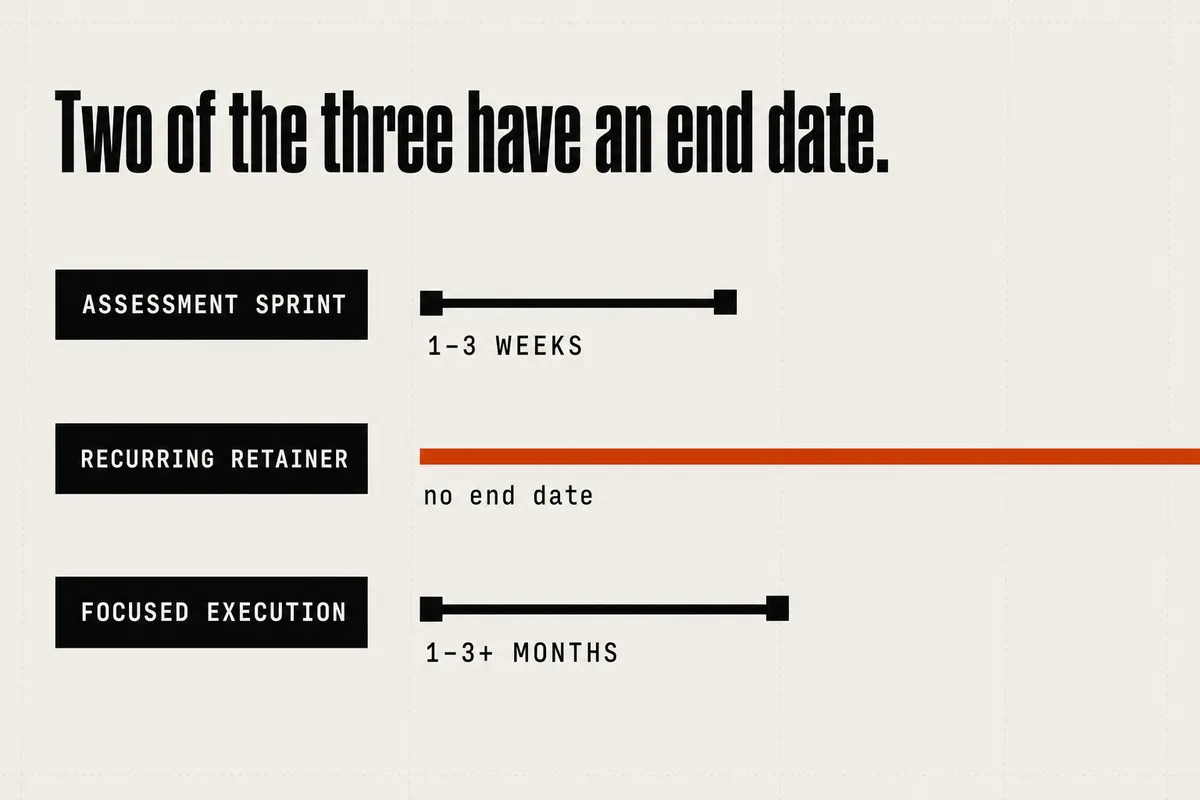
Companies asking what is fractional CTO engagement usually find three models on offer, and the choice between them is decided by whether there is a date attached to the outcome.
- Assessment sprint — one to three weeks. Preliminary diagnostics of the current state: team structure, delivery efficiency, risks and priorities. It ends with an action plan and an agreed set of success metrics.
- Recurring retainer. Ongoing leadership at a fixed cadence, under a contract that renews until the outcome is reached. Companies choose it when the need is to hold a delivery rhythm and keep managing risk, rather than to finish a specific thing.
- Focused execution with an end point — one to three months or more. System modernisation, process stabilisation, team rebuilding, or preparing a startup for launch or diligence.
The first two are the defaults. The third tends to be chosen under time pressure or when there is a specific milestone in the calendar. These duration bands are our own observation from engagement structures we see in the market, not a published figure.
What is a fractional CTO against the roles it gets confused with
The role differs from each of the three it is most often confused with, and the differences are worth setting out side by side.
| Metric | Fractional CTO | Full-time CTO | Interim CTO | Consultant |
|---|---|---|---|---|
| Engagement | Ongoing, partial | Full-time | Full-time, fixed period | On demand, hands-off |
| Position | Sits in the leadership team | Works hands-on with full commitment | Works hands-on as a transitional leader | External adviser providing independent expertise |
| Team management | ✔ | ✔ | ✔ | — |
| What you get | Leadership and accountability | Full technical leadership | Full technical leadership | Recommendations |
| Best for | Strategy, crisis work, urgent goals, scaling | Filling a permanent need | Filling a temporary need | Assessing a problem and finding a solution |
If the question behind the comparison is which employment format to buy rather than which role, that decision has its own treatment in part-time CTO vs fractional vs full-time, and the cost side is covered in fractional CTO rates and pricing models.
How to decide whether you need a fractional CTO
If you are weighing the role against the alternatives, the decision resolves along three questions.
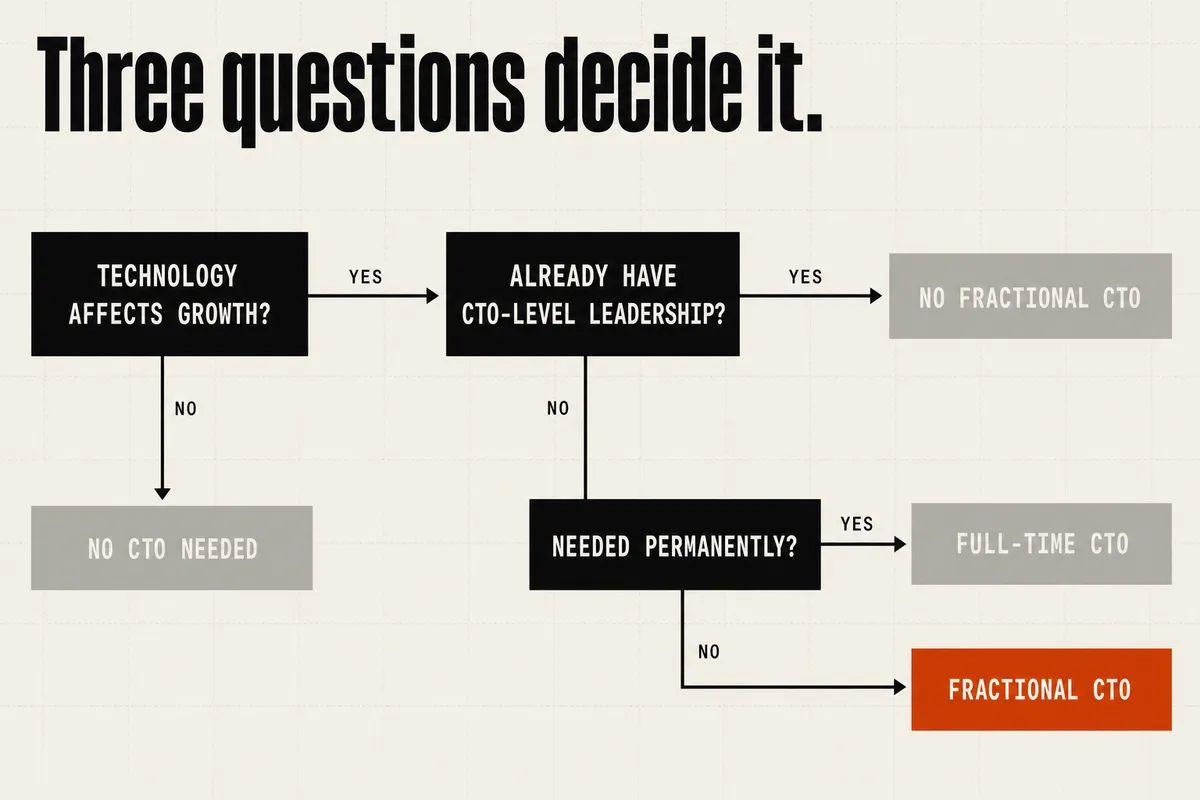
Three numbers turn that tree into a decision.
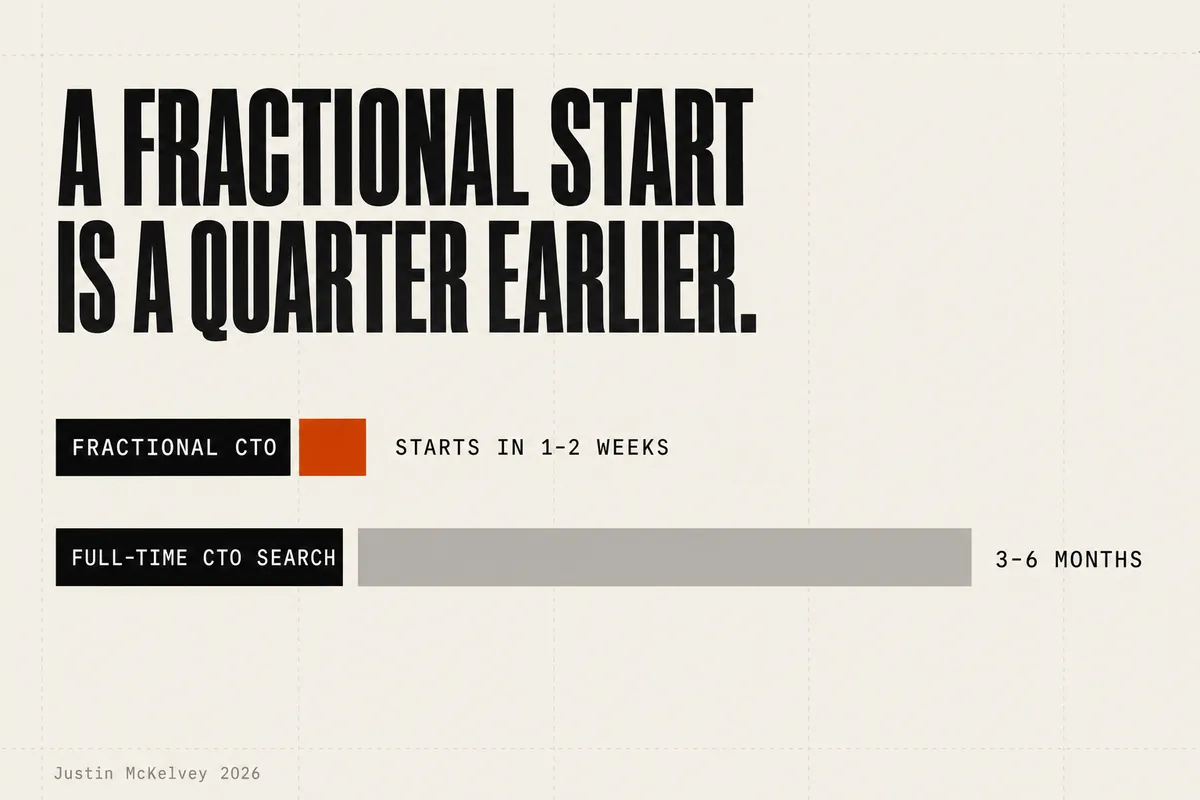
- Speed. A fractional CTO starts in one to two weeks. Finding a full-time CTO takes three to six months (Justin McKelvey).
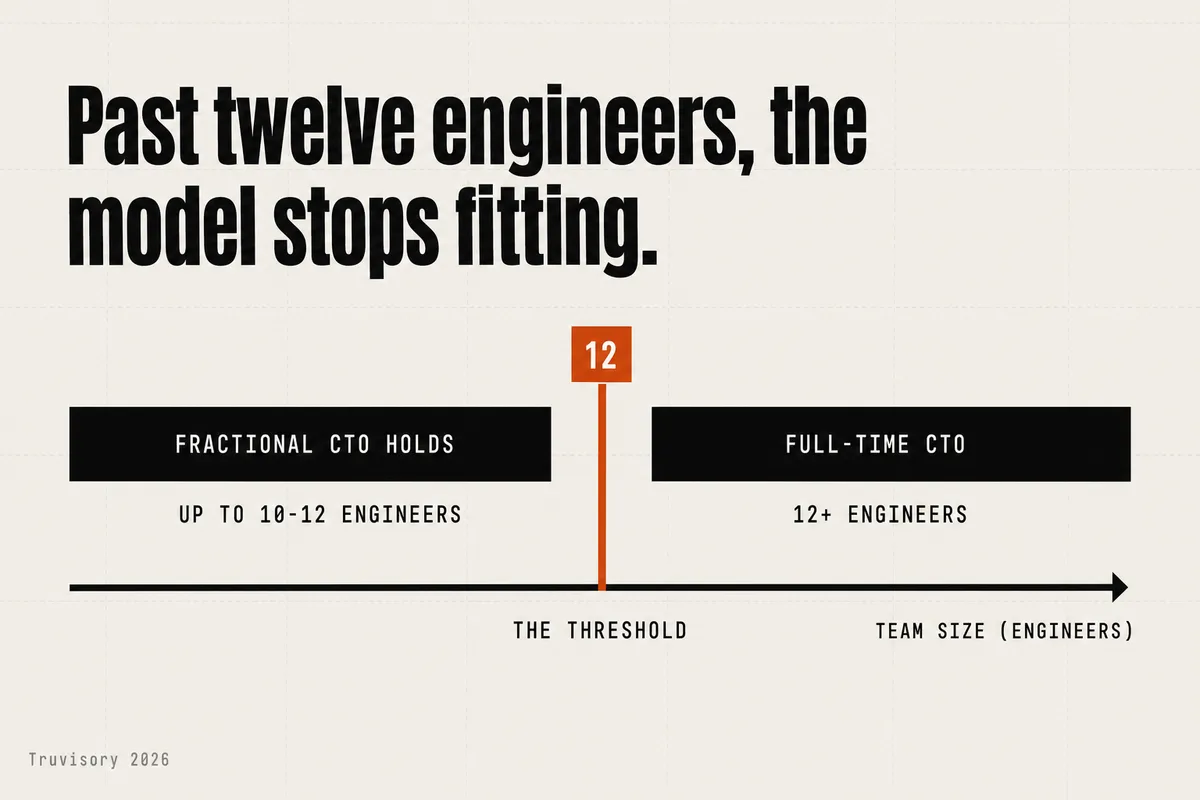
- Team size. Below roughly 10 to 12 engineers, fractional guidance is enough. Past 12, a full-time CTO is the better answer (Truvisory).
- Commitment. A fractional CTO works 10 to 20 hours a week. If that is enough to move your business goals, the model fits. If it is not, the model is the wrong purchase and no amount of seniority in the seat will fix it.
Bottom line
The fractional CTO model differs from both permanent technical leadership and technical consulting. It gives a company senior leadership for a defined purpose: startup scaling, engineering strategy, modernisation of the technology estate, targeted work on delivery risk, or diligence preparation. It also covers the case where a full-time CTO is out of budget.
The scope is wide — risk management, alignment with business goals, strategy, roadmap and oversight of the core processes. The limit is just as concrete: past twelve engineers, or past twenty hours a week of demand, you are buying the wrong thing.
Frequently asked questions
When is it feasible to hire a fractional CTO?
When the operating rhythm is unstable, when the team is not competent enough for the work assigned to it, or when there is a specific executive-level problem to solve. The common thread is that the decision needs someone senior, and the workload does not fill a permanent seat.
Can I hire a fractional CTO for a couple of weeks?
Yes, if the goal is an audit of the current state and a plan for what to do next. Two to three weeks is enough to assess team structure, delivery efficiency, risk and priorities, and to leave behind an action plan with success metrics. Deeper work — modernisation, team rebuilding, diligence preparation — needs months rather than weeks.
Can a fractional CTO work as a back-end or front-end developer if needed?
Occasionally, for short spikes. Coding skill is what gives the role credibility with the engineering team, and code review and architecture work are part of the job. But paying for senior leadership time to fill a developer seat is the wrong use of the engagement — the core work is setting priorities and making processes predictable.
Can a fractional CTO handle multiple projects at a time?
Yes. Partial engagement is what the model is, so a fractional CTO is not committed to one company full-time. Some carry several clients at once; others focus on a single contract. Ask directly how many they currently hold — the answer matters more than the fact that they hold more than one.
Does a fractional CTO work fully remotely?
That depends on the contract. A fully remote arrangement with regular reporting to the CEO is workable. A hybrid model is common too — a remote weekly cadence with occasional in-person sessions for coaching and the relationship work that is harder to do over video.
What is a fractional CTO not responsible for?
Daily executive presence, emergency fixes made without authority to approve them, hands-on senior engineering as a routine, and detached advice with no participation in delivery. A fractional CTO adopts the team’s cadence; a consultant does not, and that is the line between the two roles.
Once the role is clear, the next question is where the person comes from and how to evaluate them. That is covered in how to hire a fractional CTO.
Need help with your technical challenges?
Let's discuss how we can help you build better systems.

Oleksandr Kotliarov
Founder · Engineering Lead · Kraków, Poland
I build engineering teams that ship — from MVP to Series A delivery.