Author
Oleksandr Kotliarov
Date
August 14, 2026
Reading Time
10 min
Fractional CTO services are bought through four channels, and the choice between them decides what it costs and what happens when the person does not work out. The engagement runs the same shape whoever you buy from: define the outcome, source candidates, screen them, check references, and run a short paid trial before signing anything long.
- Define the outcome you need.
- Source candidates.
- Screen through interviews or a task assessment.
- Check references.
- Run a short paid trial before a long-term contract.
Each step below is set out in detail, because the failure modes are in the detail rather than in the sequence.
How to know whether fractional CTO services are what your company needs
The first question is whether the part-time model fits at all, or whether you are about to buy a smaller version of something you actually need in full. This table maps the common situations against the two answers.
| Situation | Fractional CTO | Full-time CTO |
|---|---|---|
| Building a product with no technical leadership | ✔ | |
| Preparing for investment, acquisition or an audit | ✔ | |
| Your permanent CTO has left | ✔ | ✔ |
| No engineering team yet, and you need to build one | ✔ | |
| An engineering team of 13 or more | ✔ | |
| You need full commitment and in-house presence | ✔ | |
| A specific product needs senior technical expertise | ✔ |
So the model earns its price for companies that need:
- Temporary reinforcement of their technical leadership.
- Preparation for a specific milestone — an acquisition, a funding round, a product launch.
- A way to scale without chaos while the strategy for the next stage is set.
- Validation of what the CTO role should be before hiring into it permanently.
- Technical leadership on a team of up to 10 to 13 engineers, where a permanent hire is hard to justify against the cost.
A step-by-step guide on how to find a fractional CTO
The sequence matters more than any single step in it.
- Define the outcomes. Name several 90-day outcomes you want from the new technical leader. They become the basis of every later decision, because the scope a fractional CTO can own is wide enough that “senior technical leadership” is not a brief. Do you want an audit of the current setup and a plan to systematise it? Someone to launch a product and run the team? A recurring retainer for gradual scaling? The goal decides the person.
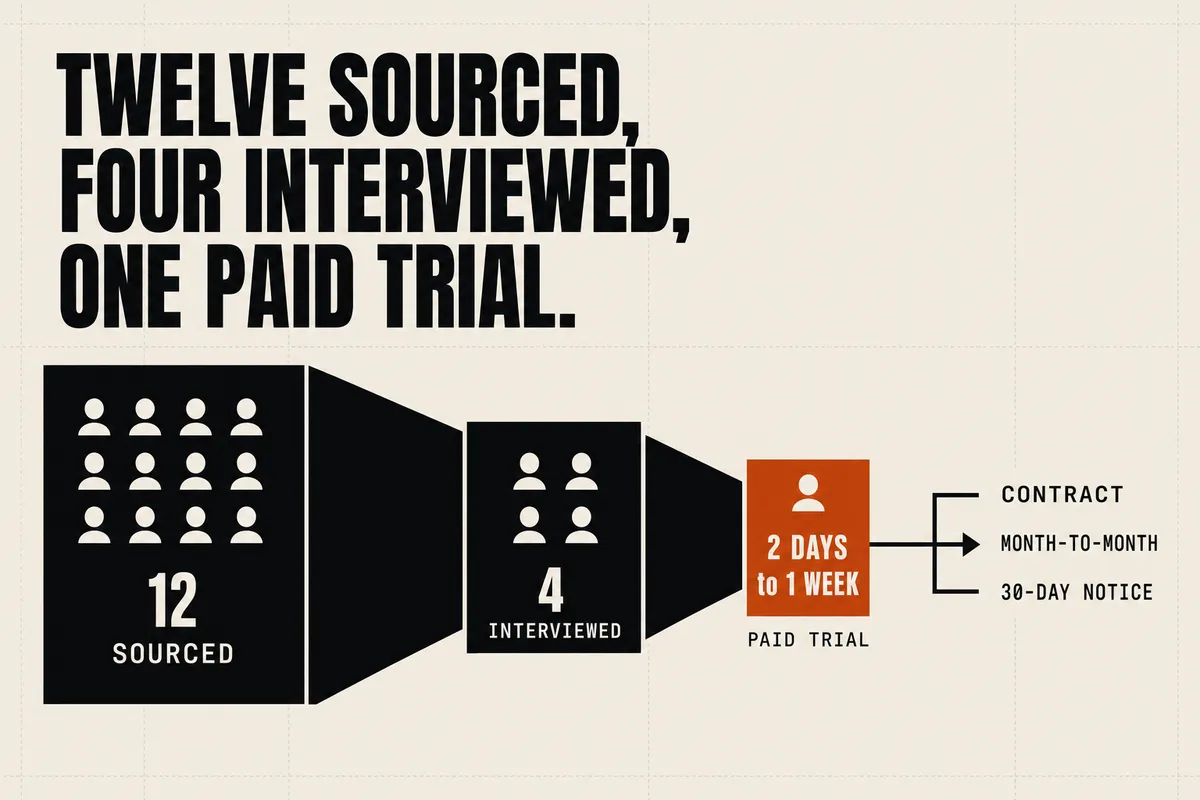
- Source the first pool. Gather up to a dozen candidates across the channels below, with CVs and references. Roughly a third of them are worth an interview.
- Run a paid trial with the candidates who pass the interview. Two days or a week is enough, and the length is your call. The trial is where technical competence and working style are both visible, which no interview delivers.
- Sign month-to-month with a 30-day notice period if the trial works (941 Consulting).
Where to find a fractional CTO — the engagement channels
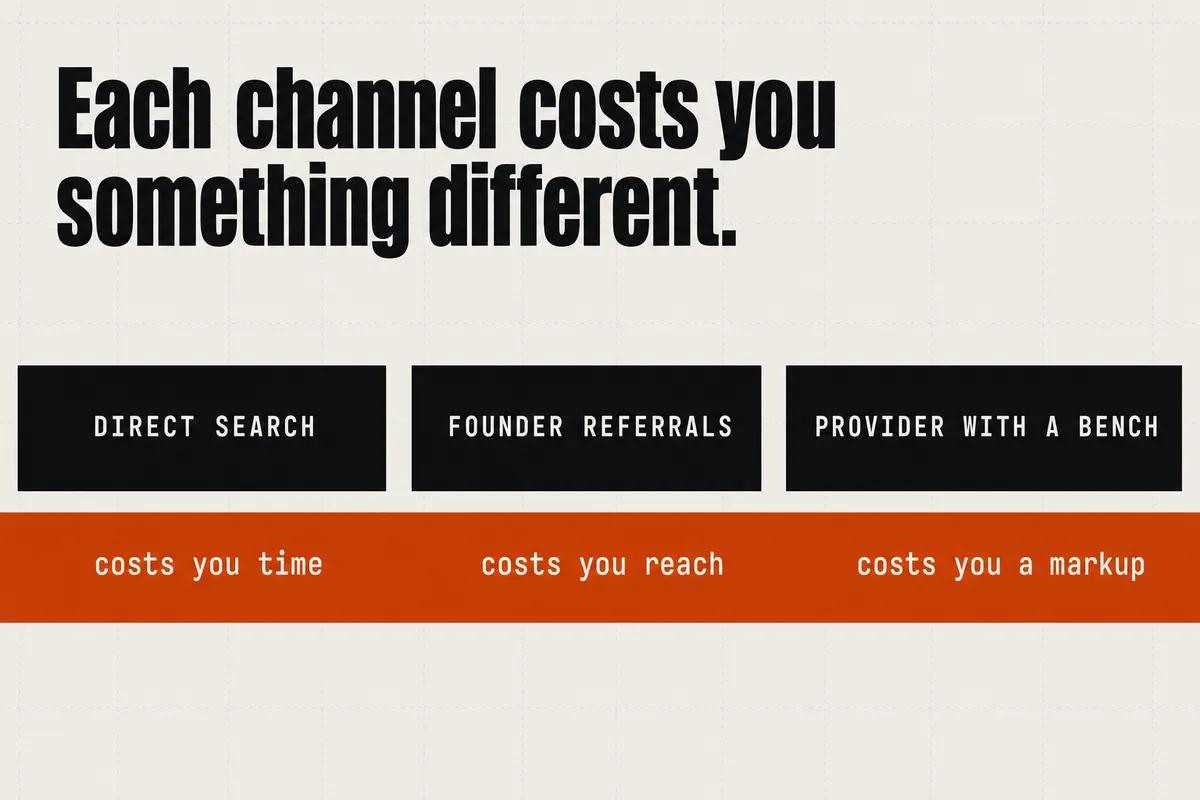
The role sits on several skill stacks at once, so the channel you source through shapes the shortlist more than it would for an ordinary technical hire. Three channels carry most of the market:
- Direct search on LinkedIn and freelance platforms.
- Referrals from other founders, CEOs and operators.
- Companies that sell fractional CTO services as a product.
Direct search
The most obvious method, and the one most in-house recruiters reach for first. Working through profiles and job platforms does produce candidates, but it takes time. LinkedIn is the more effective surface, because people doing this work are rarely browsing job boards — you are more likely to find an experienced CTO, VP of Engineering, Head of Engineering or senior technical founder willing to commit one to three days a week to another company there than anywhere a vacancy would be posted.
Founder referrals and operator networks
Referrals are a strong channel because this is a high-trust strategic role rather than a standard technical vacancy. A candidate recommended by another founder arrives with their competence already validated by someone who watched them work, which no CV does. It also gives you visibility on things an interview will not surface:
- How the person communicates with non-technical executives.
- How they handle disagreement.
- How they work under startup constraints.
- Whether they are strategic, hands-on, commercially minded, and good at managing engineers.
The trade is speed. A search that relies only on referrals can run a long time, because it is limited to the people your network happens to know.
Providers with a bench
The third channel is buying from a firm that sells this as a service. What you get for the markup:
- Faster selection.
- A wider pool to choose from.
- Lower exposure to a candidate who turns out to be unreliable or less senior than advertised.
- A replacement clause.
- A start date measured in days.
Companies that offer fractional CTO services give you a pool with documented expertise and current commitments, and — if the contract says so — the right to ask for a different person when something goes wrong.
Freelancers against fractional CTO firms — which route works better
Two routes are usually set against each other: hiring an independent directly, or buying through a firm. Both work. The differences are worth reading before you commit, because they decide what happens on the bad day rather than the good one.
| Factor | Independent | Fractional CTO firms |
|---|---|---|
| Cost | Typically lower | Higher — the markup pays for the rest of this column |
| Speed | Varies with your network and the channel | Fast, from an existing bench |
| Choice of candidate | Entirely yours to find | Matched against your brief from a pool |
| Consistency of quality | Varies by individual | More predictable |
| References | You verify them yourself | Verified, with track records |
| Replacement | You start the search again | Provided under the contract |
| Contract management | Yours | Handled by the provider |
| Concentration risk | One person, single point of failure | Backed by an organisation |
Firms give you breadth and carry the selection, the contracting, the replacement clause and the verified references. That suits founders who value speed and continuity. An independent gives you exactly the person you interviewed, at a lower rate, with no substitution risk and no bench behind them. Rate bands for both are covered in what a fractional CTO costs; if you are still deciding which model to buy at all, part-time vs fractional vs full-time is the earlier decision.
The red flags worth acting on
Not every candidate who can do the work can do it for you. These are the signals that a person will not fit, in rough order of how often they turn out to matter:
- Too many concurrent clients. Fractional CTOs hold several engagements by definition. Past a certain number the attention per client drops and management gaps open up. Ask for the current count, not the maximum.
- Management with no engineering underneath it. The role does not require daily coding, but a candidate who only manages engineers tends to lose credibility with the team. A strong fractional CTO still reviews code and understands the architecture in depth.
- Only large-company experience. Demand for this model comes mostly from smaller companies and startups. Someone whose whole career sat inside large organisations often struggles with the constraints.
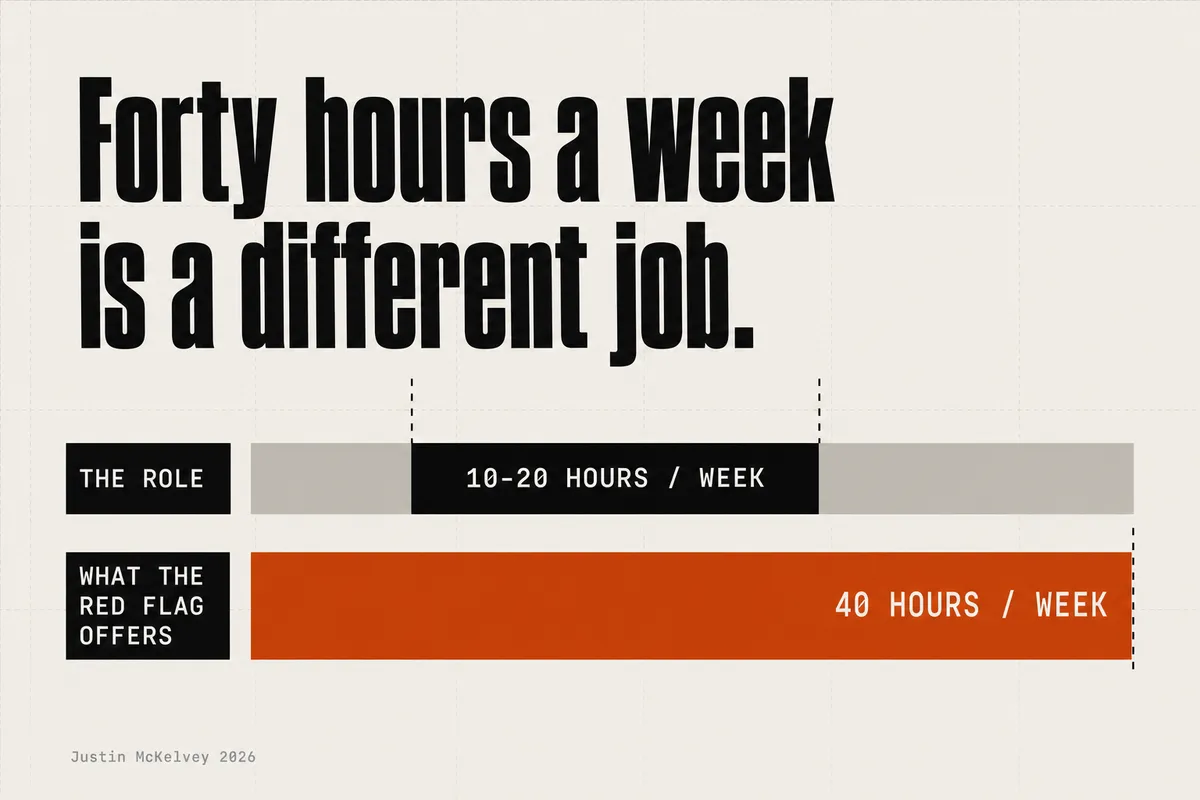
- Overcommitment on hours. The role runs at 10 to 20 hours a week (Justin McKelvey). A candidate offering 40 is describing a full-time position under a different name, and the arithmetic will not hold once they have a second client.
- References given in “we” with no account of the decision. The same applies to references that name impressive companies but no relevant work. You are trying to establish what this person decided, not what their employer shipped.
How to hire fractional CTO talent risk-free — the interview
Once the shortlist is validated and the references check out, the interview is where the remaining risk sits. These questions and the answer patterns beside them are a starting set.
| Question | Weak answer | Strong answer |
|---|---|---|
| How do you translate business goals into technical strategy? | Names technologies and tools with no framework around them. | Starts with a framework — audit, alignment, prioritisation, and the trade-offs the strategy accepts. |
| Have you refused to implement a technical decision a founder wanted? What happened? | No such example, or the disagreement ended the engagement. | A concrete example with the reasoning, an alternative offered, and the relationship intact afterwards. |
| Walk me through preparing a company for due diligence. | Vague description with nothing specific in it. | A systematic approach, with real examples of what was found and fixed. |
| How do you evaluate build against buy? | Defaults to one answer without weighing the other. | Names the criteria — strategic value, team capability, long-term cost, integration complexity — and gives worked examples. |
| Is there a technical decision you regret? What did you learn? | No example, or no conclusion drawn from it. | A clear example with an honest account of what went wrong. |
| Describe a technical decision that worked and what it produced. | A vague example with no stages and no reflection. | Context, the solution, why it was chosen, and the outcome it produced. |
| What does a healthy engineering team look like to you? | Delivery metrics only, no view on culture or growth. | Both — delivery metrics and the cultural conditions that hold them up. |
| Would you trade engineering velocity against quality? | Picks a side without diagnosing the situation. | Starts with diagnosis and blocker removal, and explains how the trade is usually avoidable. |
| How do you coach engineers? | No practice of their own; hands mentorship to HR. | Specific examples of mentoring individuals and what changed. |
| How do you handle disagreement between engineering and product? | A combative account. | A facilitating one. |
Adapt these to your own situation, and add questions about relevant sector experience where the domain carries real constraints — fintech, AI products, healthcare and other regulated domains all do.
What companies that offer fractional CTO services put in the contract
Contract management usually falls to the founder, so the shape of the agreement is worth knowing before the conversation. Three models cover almost all of it.
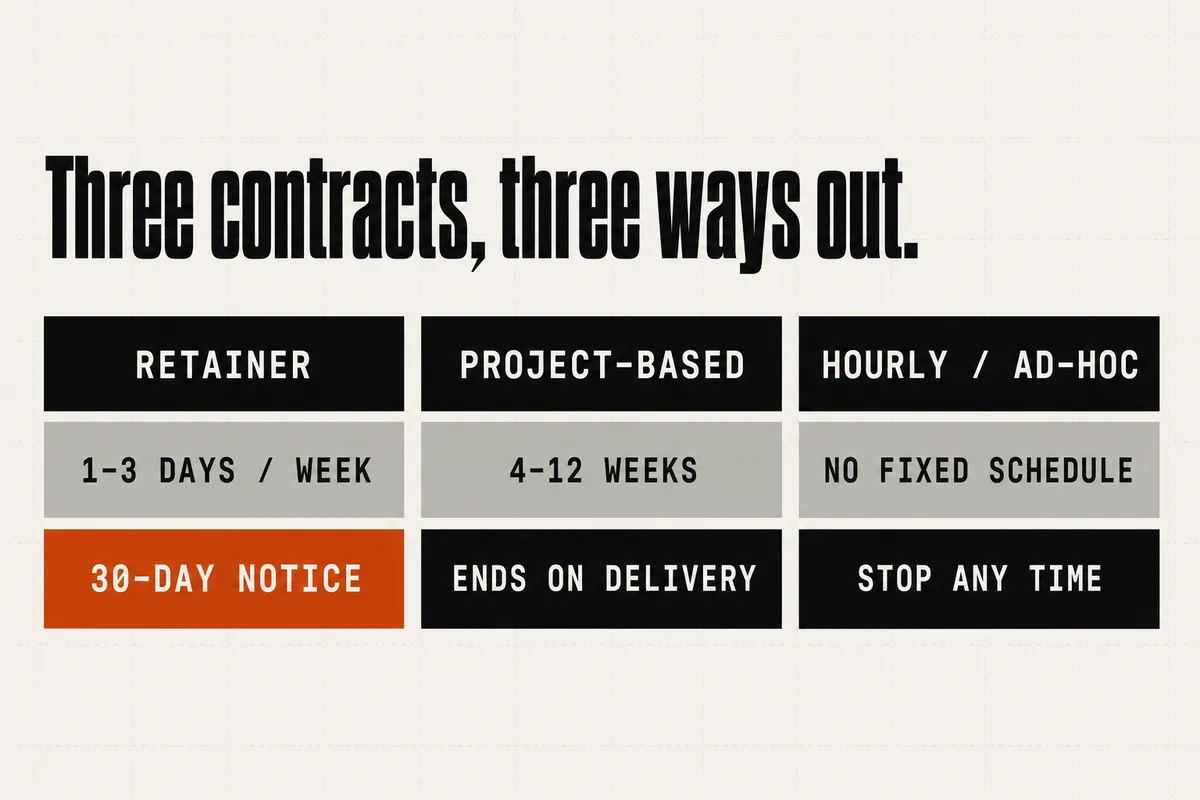
Durations and notice periods above reflect the contract structures we see in the market rather than a published survey. The notice period is the term to read twice. It is what you are buying when you pay an agency markup, and it is what you are exposed to when you do not.
When to move to a full-time CTO
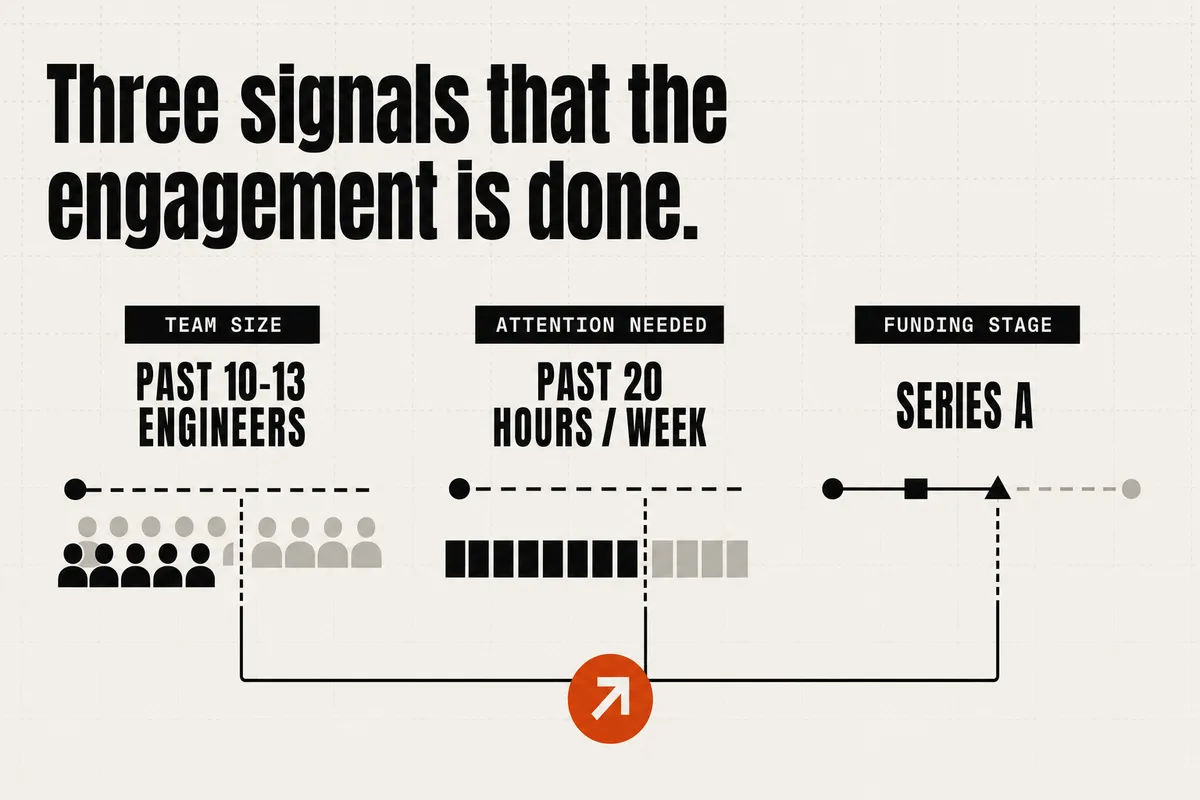
Every fractional engagement is temporary, and part of running one well is knowing when it has done its job. The signals:
- The engineering team grows past 10 to 13 people.
- Technical strategy becomes the core competitive advantage, which needs more commitment than the model provides.
- You need more than 20 hours of the CTO’s attention per week.
- The company approaches Series A.
- The arrangement starts to be the bottleneck rather than the thing removing them.
Recap
Companies buy fractional CTO services for different reasons — budget that does not stretch to a permanent hire, a product or startup that needs decisions quickly, or a deliberate stage on the way to scaling, funding or acquisition.
In all three, the choice of person decides the outcome. Whichever route you take to hire fractional CTO support, the role spans technical strategy, decision-making, team management and risk, so the candidate has to carry the technical weight and fit how the company already works. If running that selection yourself is not a good use of your time, buying from companies that offer fractional CTO services moves the sourcing, the contracting and the replacement risk off your desk — which is worth the markup exactly when speed and continuity are what you are short of.
Frequently asked questions
Is it realistic to hire a fractional CTO through personal search instead of an agency?
It is possible, but only if you already have the network and can get peer recommendations on the specific person. Providers are the more reliable route because of formal contracting and written replacement terms. A personal search without a network tends to run for months and end with a candidate nobody can vouch for.
Should a startup hire a technical consultant or a fractional CTO?
If there is no technical leadership at all and the gap has a defined duration, engage a fractional CTO. Technical consulting does not give you strategic planning or supervision of delivery — it gives you an assessment. Consulting works before Series A; through it, the operating cadence of a fractional CTO is what fills the gap. The difference between the two roles is set out in what a fractional CTO is.
How quickly can a fractional CTO start?
Within a couple of weeks in most cases, against three to six months to run a full-time CTO search. Speed is the main practical advantage of the model. A provider with a bench can move faster still, because the sourcing step is already done.
How many hours does a fractional CTO dedicate to one project?
Typically 10 to 20 hours per week, either fully remote or on a hybrid arrangement. The part-time basis is what the model is. A candidate who offers 40 hours a week is describing a full-time job under a different name.
How many candidates should I evaluate?
Source roughly a dozen against your first-line requirements — the leadership gap and outcomes you named, the engagement model you need, and technical credibility at your stage. Take three or four of those to interview and decide from that group. Hiring the first person you speak to is the most common way this goes wrong.
What happens if the person does not fit?
That depends on the contract and on where you hired from. With a provider, replacement terms can be written in at the start, and invoking them is a conversation rather than a new search. With an independent, you fall back on the notice period — typically 30 to 60 days, used for handover of documentation and credentials.
If you are earlier than this and still working out what the role covers, start with what a fractional CTO is. Adjacent provider types — virtual CTO services and CTO consulting — sit next to this decision and are not the same purchase.
Need help with your technical challenges?
Let's discuss how we can help you build better systems.

Oleksandr Kotliarov
Founder · Engineering Lead · Kraków, Poland
I build engineering teams that ship — from MVP to Series A delivery.