Author
Oleksandr Kotliarov
Date
June 16, 2026
Reading Time
6 min
ISO 27001 for SaaS sits in the same conversation as SOC 2, but it answers a different question. SOC 2 tells a US buyer that your security practices are real. ISO 27001 tells a European or international buyer the same thing, in the language their procurement team already speaks. SaaS companies that ignore the distinction lose six-figure enterprise deals to certified competitors.
What ISO 27001 for SaaS actually requires
ISO 27001 is the international standard for an Information Security Management System. The word that does the work is system: the certificate is for the way the company manages information security across people, processes, and infrastructure, not the product. The 2022 revision lists 93 controls in Annex A across organisational, people, physical, and technological categories.
For most companies, ISO 27001 compliance for SaaS companies touches the same surfaces SOC 2 does — access control, change management, incident response, vendor management — plus a few SOC 2 treats lightly: explicit risk treatment plans, statement of applicability, ongoing management review.
| Property | ISO 27001 | SOC 2 Type II |
|---|---|---|
| Geography | International, strong in EU | Strong in North America |
| Audit cycle | 3-year cert + annual surveillance | Annual report |
| Format | Pass/fail certificate | Auditor’s opinion + report |
| Scoping | Statement of Applicability | Trust Services Criteria |
| First-time cost | $40k–$120k all-in (15-person co) | $30k–$80k all-in |
The ISO 27001 certification process for SaaS companies
The iso 27001 certification process for SaaS companies breaks into four phases. The realistic timeline is six to nine months for a first certification:
┌────────────────┐  ┌────────────────┐  ┌────────────────┐  ┌────────────────┐
│ Gap assessment │→ │ Control build  │→ │ Internal audit │→ │ Stage 1 + 2    │
│  Weeks 0–3     │  │  Weeks 2–20    │  │  Weeks 18–22   │  │  Weeks 22–28   │
└────────────────┘  └────────────────┘  └────────────────┘  └────────────────┘
Gap assessment. A consultant or internal lead maps your current state against Annex A controls. You finish with a written gap list, a risk register, and a Statement of Applicability draft.
Control build-out. Most of the work. Policies get written or rewritten, tooling gets adopted (a compliance platform like Vanta, Drata, or Secureframe is standard), evidence collection starts running.
Internal audit. A pre-audit you run on yourself to catch gaps before the certification body sees them. Usually outsourced to a specialist for the first cycle.
Stage 1 + Stage 2 audit. An accredited certification body reviews your documentation (Stage 1) and tests your controls in practice (Stage 2). Pass and you receive a three-year certificate with annual surveillance audits.
The realistic cost of ISO 27001 compliance for SaaS companies
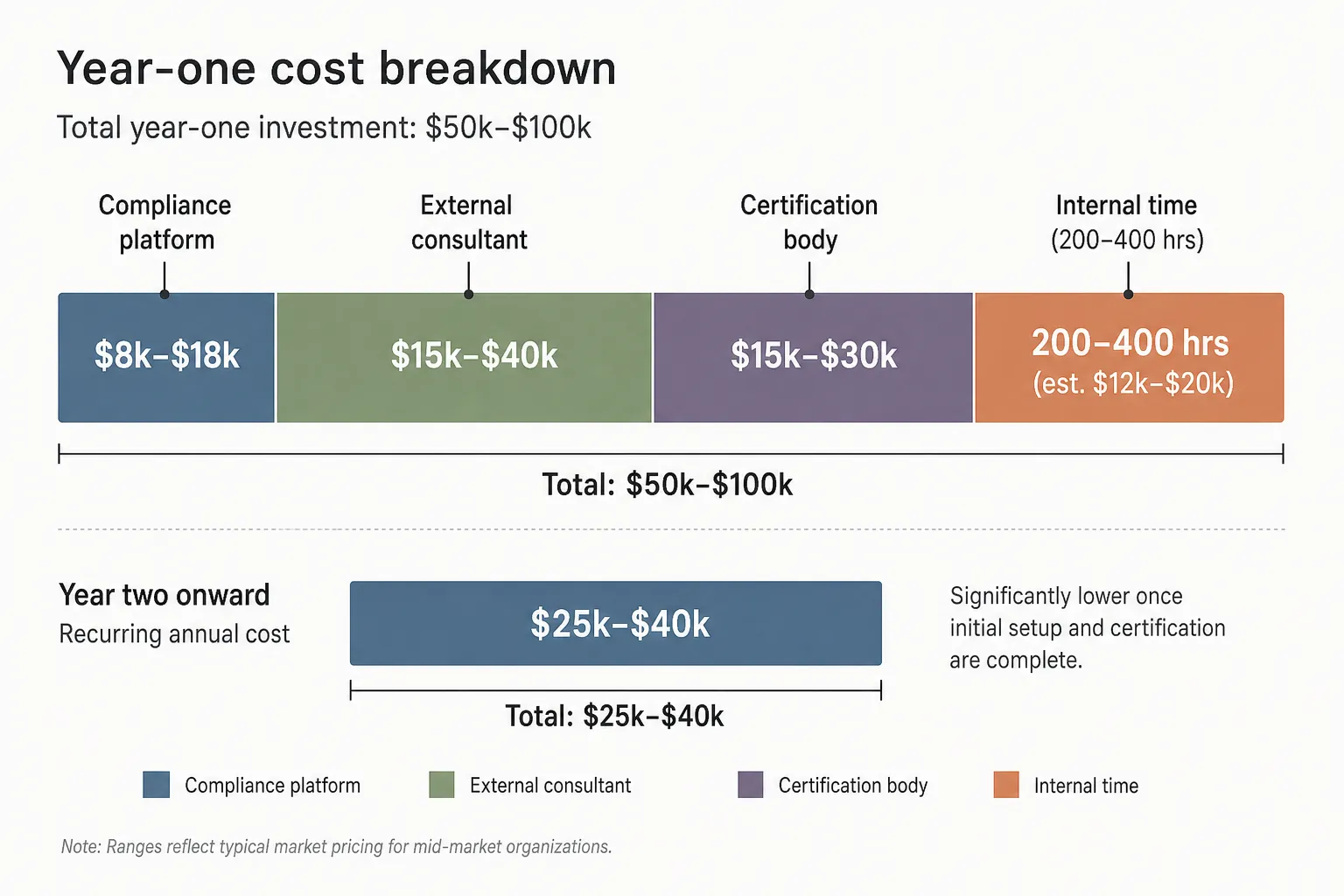
The cost ranges quoted online are useless because they conflate four different line items. The real ISO 27001 compliance steps for SaaS companies cost looks like this for a 15-person SaaS:
- Compliance platform. $8k–$18k per year. Pays for itself in evidence collection time.
- External consultant. $15k–$40k for the gap assessment and policy work, optional but usually worth it on first attempt.
- Certification body. $15k–$30k for Stage 1 + Stage 2. Recurs annually for surveillance.
- Internal time. 200–400 engineering hours over the engagement. The largest hidden cost, and the one most CFO models miss.
Year-one all-in: typically $50k to $100k for a first-time small SaaS. Year-two onwards: $25k to $40k for the platform and surveillance audit.
The benefits of ISO 27001 certification for SaaS companies
The benefits of ISO 27001 certification for SaaS companies are easier to count than to claim. Specifically:
- Enterprise deals in regulated EU markets (financial services, healthcare, public sector) stop asking for SOC 2 alternatives.
- Cyber insurance renewals get cheaper, often by 15–30% at first renewal post-certification.
- Vendor security questionnaires shrink from 200 questions to a request for the certificate and the SoA.
- Internal incident-response and risk-register hygiene improves measurably — the ISO 27001 importance for SaaS companies that ship to enterprise is mostly about this, not the badge.
The hidden benefit, and the one we point to most: the certification forces a cross-functional review of who owns what risk. That conversation rarely happens otherwise, and the artefacts that come out of it outlast the certification cycle.
SaaS-specific gotchas in ISO 27001 for SaaS audits
A few controls catch SaaS teams off guard in their first audit:
- Cryptographic controls (A.8.24). Key management policies must be written, owners assigned, and rotation cadence documented. Most SaaS companies have the practice but not the paper.
- Supplier management (A.5.19–A.5.22). Every third-party vendor needs a documented risk assessment. Auditors will spot-check three of them.
- Secure development (A.8.25–A.8.31). Code review, branch protection, secrets scanning — auditors increasingly ask for evidence, not assertions.
None of these are technically difficult. They are documentation-difficult, which is why the certification is mostly a writing project that engineers tend to underestimate by half.
Need help with your technical challenges?
Let's discuss how we can help you build better systems.

Oleksandr Kotliarov
Founder · Engineering Lead · Kraków, Poland
I build engineering teams that ship — from MVP to Series A delivery.